
In this video, Jonathon Bleakley shares essential tips and personal insights for anyone transitioning from traditional boats to personal watercraft (PWC).
Jet ski handling tips with Jonathon Bleakley
Well, PWCs have to be up there with some of the most fun you can have on the water. They're fast, they're nimble, and they are literally your own personal watercraft. However, they handle very differently from a traditional boat.
G'day, it's Jono and welcome to Club Marine. Today we're talking about the basics of jet ski handling. I'm a newcomer to this and have only been using one for about six months, so I've had to learn a lot of this the hard way. Today, I'm going to run through the top tips I've learned when it comes to driving one of these machines.
Now, I know we're talking about handling on the water, but let's be honest, every boating journey starts with getting the craft to the ramp. There are a few things you need to know about a PWC. First, the advantages: they are much lighter than a boat and are far more fuel-efficient on the road. You can tow them with an SUV; you certainly don't need a dual-cab ute. You can also store one in a much smaller garage, making them ideal for city living. There are plenty of advantages in that regard.
The main downside is reversing them down the boat ramp. Because they are much shorter and narrower, they can be harder to see in your mirrors than a boat. A small turn of the steering wheel is also exaggerated because of the shorter trailer. Early on, I found that getting the PWC from the rigging bay into the water was actually more difficult than doing the same with a boat.
Once you are at the water, however, launching a PWC is an absolute breeze. After spending days fishing from a boat, jumping onto one of these feels fantastic. Because it is so light, I can launch it by myself. If there is a bit of wind or current, I can simply grab it and manoeuvre it, unlike a larger boat.
That said, there are a few things to remember. One thing I've noticed is that, unlike a boat, the PWC is so light that when I undo the ratchet strap it wants to slide off the trailer. It is not a major problem, but it means that either a friend needs to move the vehicle slightly to take the tension off the strap, or you need a rope to help pull it forward. If you simply unhook it and let go, it can slide straight off the trailer.
Before doing anything, the safety lanyard must always be attached. That should never be overlooked. To get the PWC off the trailer, if it is currently in forward gear, all I need to do is put it into neutral and it will gently drift off on its own. That is one of the reasons I enjoy fishing from these machines; they are very easy to manage alone.
Getting a PWC back onto the trailer can be more challenging. Once you factor in the handling characteristics and the narrow trailer you are aiming for, accuracy becomes important. My advice is to pick a line, commit to it confidently, and take it slowly. Unlike a boat, you cannot easily correct your approach at the last moment. Yes, you can use reverse, but it is not as straightforward. I prefer to line up carefully, apply gentle throttle, drive straight onto the trailer, and then switch off the engine. One thing to remember is that you should keep it in gear; otherwise, it will drift straight back off the trailer.
One of the biggest misconceptions I hear about PWCs is their stability and how they cope with weight distribution on the water. It's a fair question, but in six months of use I have had no problems whatsoever. People often wonder whether the craft will tip over if they move around, stand to one side, or fight a fish from one side while fishing.
In calm water, which is where I recommend beginners start, I have found them surprisingly stable. I spend a lot of time standing and moving around while fishing, and at no point have I felt as though the craft was going to roll over. There is certainly more movement than you would experience in a boat, but for such a small vessel it remains impressively stable. If I put all my weight on one side, the craft does lean, but I still never feel as though it is going to flip.
If there are two people on board, communication becomes important. Two people shifting their weight can have a much greater effect on the craft. Most of the time, however, I fish alone and find it perfectly manageable.
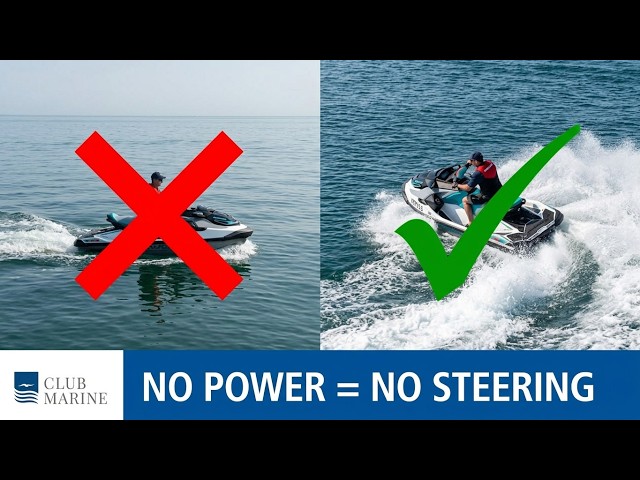
Now for the golden rule - the one that completely caught me out the first time I rode a PWC. It concerns steering. If there is no water moving through the jet, the handlebars are effectively useless.
Unlike a traditional boat with an outboard motor, propeller and rudder, a PWC relies entirely on jet propulsion for steering. With a boat, if you are moving and turn the wheel, the hull will respond. With a PWC, if there is no water being pushed through the jet, turning the handlebars achieves nothing.
In practical terms, this means that if you are travelling at speed and suddenly release the throttle, you lose much of your steering response. The same thing applies when approaching a trailer, a pontoon, a friend in the water, or any other target. If you cut the power too early, the craft will continue travelling with little or no steering control. It is not a flaw; it is simply how the system works, and it is something every rider must understand because it can become dangerous if ignored.
You can see this clearly when travelling slowly. With the engine providing thrust, the PWC responds to steering inputs. As soon as the engine is cut and water is no longer being forced through the jet, the steering becomes ineffective.
Another difference compared with a boat is the throttle and gear system. You do not have a conventional throttle lever showing forward, neutral, or reverse. Instead, it is all controlled from the handlebars, much like a motorcycle.
When you first start using a PWC it can be confusing, but after a week or two it becomes second nature. When the display shows neutral, the jet is still operating and creating water movement, even though the craft is not moving forwards or backwards. Neutral does not mean completely stationary. The craft can still pivot depending on the position of the handlebars.
To move forwards, select forward gear. Once engaged, the craft is ready to go whether or not you are applying throttle. To reverse, you hold the reverse control. Releasing it returns the craft towards neutral. It may feel slightly fiddly at first, but it is actually an excellent system because you have complete control using your fingers. The important thing is to understand how it works, particularly when approaching a pontoon or loading onto a trailer, because one incorrect input can result in a collision.
Like boats, PWCs do not have traditional brakes. Because you are riding a personal watercraft rather than sitting inside a boat, it is even more important to plan your approach and manage your speed. If you simply release the throttle at the last second, the craft will continue moving. When approaching shallow water, a boat ramp, or any structure, slow down early and maintain a controlled speed so that the craft continues to respond to steering inputs.
The most important safety feature is the emergency lanyard. At all times it should be attached to your life jacket. This is not optional. Because PWCs are capable of travelling at very high speeds, the lanyard is your primary safety device. If you fall off, it immediately stops the craft from continuing into the distance without you.
It's been a beautiful day out on the water and I've had some fantastic adventures on this machine over the past few months. I've caught big cobia, explored beautiful islands, and even taken it offshore. One day you'll likely reach that level as well. For now, though, I'm going to enjoy exploring my local estuary because it's an absolute cracker of a day.
RELATED VIDEOS


Any advice here does not take into account your individual objectives, financial situation or needs. Terms, conditions, limits and exclusions apply. Before making a decision about Club Marine boat insurance, consider the Product Disclosure Statement (PDS)/Policy Document and Supplementary PDS (if applicable). Where applicable, the PDS/Policy Document, Supplementary PDS and Target Market Determination (TMD) for Club Marine boat insurance are available on this website. We do not provide any form of advice if you call us to enquire about or purchase a product.
Club Marine Limited (ABN 12 007 588 347), AFSL 236916 issues Club Marine boat insurance and handles and settles claims as agent for the insurer Allianz Australia Insurance Limited (ABN 15 000 122 850) AFSL 234708 (Allianz). Club Marine Limited is a related body corporate of Allianz. Copyright © 2026 Allianz Australia Limited.