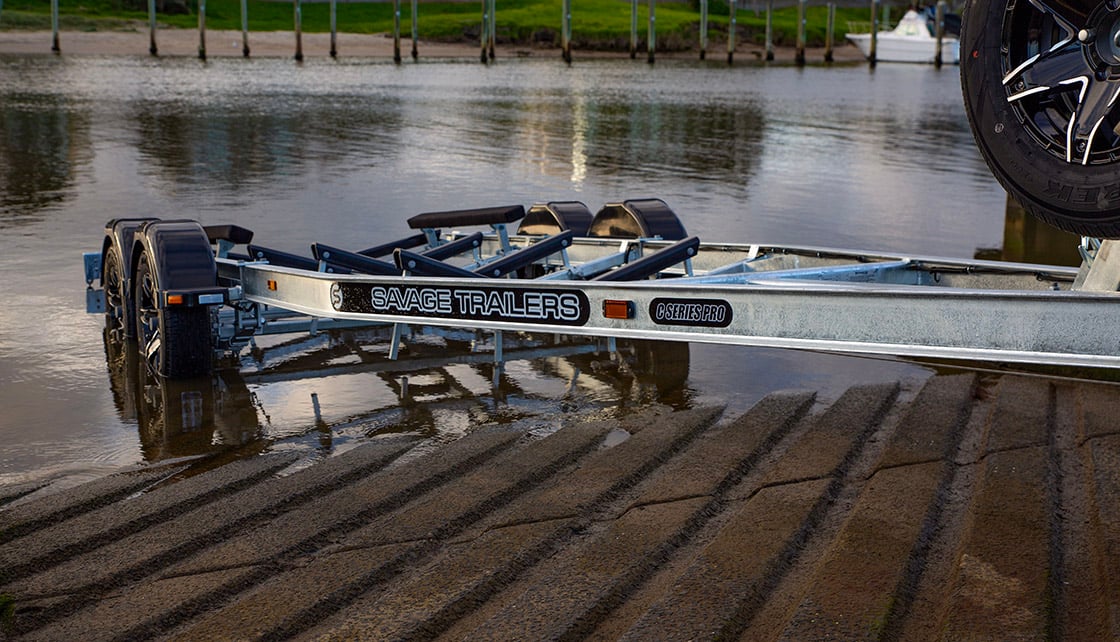
Buyers’ guide to boat trailers

Mark Rothfield
The road to towing nirvana starts with a reliable, well-equipped trailer.

All boat, motor and trailer (BMT) packages are born equal, yet some are more equal than others. The boat gets the affection, the motor gets the glory, while the trailer sits there largely overlooked, quietly minding its own business.

Minding is the trailer’s business, though, as these unsung heroes cradle your valuable hull as you traverse Australia’s potholed and corrugated byways. As such, they’re the last thing you want to go wrong but often the first thing you’re tempted to economise on.
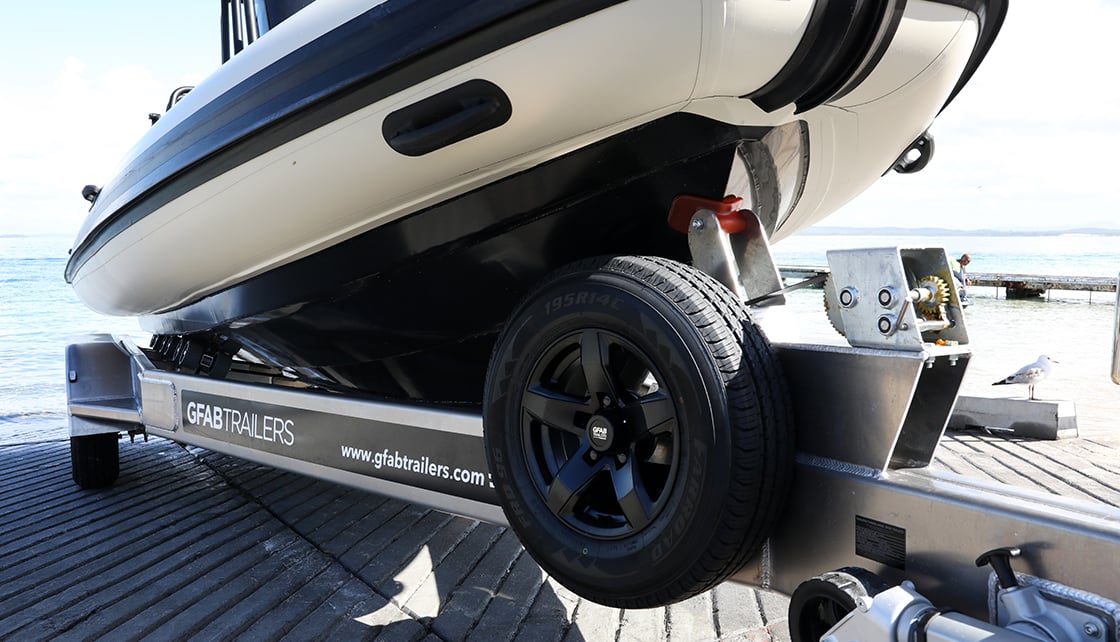
Your existing rig can provide many answers to what you require, as will the trailer supplier if you’re starting afresh. It also pays to research what’s popular among other owners of your boat model.

When it comes to determining quality needs, and hence your likely budget, think about your usage patterns. Does it involve long-distance journeys, single-handed operation, beach launching, 4WD tracks, or none of the above?

Generally speaking, quality products cost more but last longer.

When it comes to sizing the trailer, the key measurement is bow eye to transom. Trailer suppliers also need to know the beam, deadrise angle, and dimensions of the chines, strakes and steps (if applicable).

Overall trailer length and axle positioning inherently impact both weight distribution and handling dynamics. Critically, the rig must have around 7-15 per cent of the total weight distributed on the tow coupling.

Insufficient downforce on the ball contributes to trailer sway and, in extreme circumstances, may jackknife and even overturn the tow vehicle. That said, your ball weight can’t exceed the maximum limit mandated by your vehicle manufacturer.

To calculate the trailer’s load capacity, you combine the weights of the hull, engine, batteries, fuel, water and gear. For fuel, multiply litres by 0.8 to determine the kilogram figure (water is 1:1). Then add a minimum 15 per cent safety margin.

Trailer compliance plates are a wealth of information in this regard, although the terminology isn’t straightforward.

  • Tare refers to the weight of the unladen trailer with all its fittings.
  • Gross Trailer Mass (GTM) is the rated maximum weight that can be carried by the wheels when the trailer is hitched to the tow vehicle.
  • Aggregate Trailer Mass (ATM) is the total weight of the trailer when carrying the maximum load, measured with the trailer resting on its jockey wheel.
  • GCVM (Gross Combined Vehicle Mass) refers to the combined mass of the trailer, tow vehicle, passengers and cargo, with car manufacturers setting a maximum rating, along with weight limits for braked and unbraked trailers.

As large trailerboats push the limits of today’s tow-horses, GCVM has spurred the rise of alloy trailers. Shedding kilos from the trailer, compared with steel, makes a big difference to GCVM and your car’s performance.

Marine-grade alloy trailers are maintenance-friendly in that they don’t rust, although still prone to galvanic corrosion and salt pitting. Hot-dipped galvanised steel trailers are more affordable, readily repairable and rigid. 

Total boat weight also determines the number of axles, although there are variables with axle, hub, bearing and tyre capacities. As a rough guide, the tipping point for single axle to dual axle is around 17-18ft (5.2-5.5m), then 24-27ft (7.3-8.2m) onwards for dual to triple axle. RIBs and pressed tinnies are lighter and can therefore be longer.

Single-axle rigs are more manoeuvrable, less complex and therefore lower in maintenance needs, while multi-axles offer better weight distribution which translates to more docility under tow and easier running over rough terrain. 

There are three distinct trailer types – keel-roller/bunk, multi-roller and bunk. Choose wisely, as the wrong configuration can cause structural damage to your hull and potentially void your boat’s warranty.

With keel-roller/bunk trailers, most of the hull weight is supported by horizontal rollers or pads along the centreline, and skids or rollers are placed either side for lateral stability. Pressed alloy boats must be supported in this way but not rotomoulded plastic boats or soft-floor inflatables.  

A true multi-roller design has no keel support as the hull is suspended in the vee between rows of rollers. In many cases, the fibreglass or plate alloy hull will sit lower in the cradle and should roll with the least resistance of any trailers.

Bunk trailers, the predominant choice in the ski and wake markets, comprise two or more carpeted side pads that support the hull from bow to stern. For many outboard-powered hulls, there’s also a keel pad. 

It might seem odd that old-fashioned leaf springs pioneered on horse-drawn carriages in the 18th Century are still widely favoured for boat trailers, but it’s a low-cost, low-tech, low-maintenance solution.

Torsion systems, comprising a torsion bar restrained by a rubber core, are another option that some (not all) manufacturers believe offer superior cushioning and ride.

Your trailer needs brakes when the GTM is 750kg or above. This can be an override system that uses inertia to push against the coupling lever then tension wires leading back to the disc callipers, activating on one axle.

From 2000kg to 4500kg GTM, the trailer requires electric or hydraulic brakes on all axles. The trailer also must have an automatic break-away braking actuator. Above 4500kg GTM, you’re looking at even more complex systems.

Car tyres designed for traction, turning ability and quietness aren’t necessarily the best option for a rig that prioritises cargo carrying, straight-line stability and durability.

Factors that need to be considered include ATM and tare weight, suspension type and more. Typically, you’ll find rim sizes vary from 13in to 15in. Smaller diameter tyres keep the rig lower but spin more times per kilometre, which adds heat and wear to the bearings.

Often, it’s the smaller accessories that make a significant difference trouble-free operation. Well-sealed LED lights, for example, will save you lots of grief, and a flat 7- or 12-pin plug is usually your best option. 

Jockey wheels do the heavy lifting. You can pay a hundred dollars for a basic unit and over $800 for a top-range Fulton aluminium model. A drop-down spare wheel is a smart option for beach launching. 

In terms of winch capacity, the common rule is to divide the boat weight by 1.5, or even 1.25 if you use steeper ramps. 

Ultimately, you can spend as much or as little as you like – Australia has more than 60 boat trailer builders and suppliers offering everything from off-the-shelf models to customised one-offs. Just remember how important the trailer is to ensuring trouble-free towing and that, in the long run, there’s no substitute for quality.

Give us a call on 1300 00 CLUB (2582)
Any discounts offered are applied to our standard rates. Promotional or other discounts may apply from time to time. Minimum premiums may apply. Any discounts/entitlements only apply to the extent any minimum premium is not reached. Where discounts are applied, your premium is subject to rounding. If you are eligible for more than one, we also apply each of them in a predetermined order to the premium (excluding taxes and government charges) as reduced by any prior applied discounts/entitlements.

Any advice here does not take into account your individual objectives, financial situation or needs. Terms, conditions, limits and exclusions apply. Before making a decision about Club Marine boat insurance, consider the Product Disclosure Statement (PDS)/Policy Document and Supplementary PDS (if applicable). Where applicable, the PDS/Policy Document, Supplementary PDS and Target Market Determination (TMD) for Club Marine boat insurance are available on this website. We do not provide any form of advice if you call us to enquire about or purchase a product.

Club Marine Limited (ABN 12 007 588 347), AFSL 236916 issues Club Marine boat insurance and handles and settles claims as agent for the insurer Allianz Australia Insurance Limited (ABN 15 000 122 850) AFSL 234708 (Allianz). Club Marine Limited is a related body corporate of Allianz. Copyright © 2026 Allianz Australia Limited.