
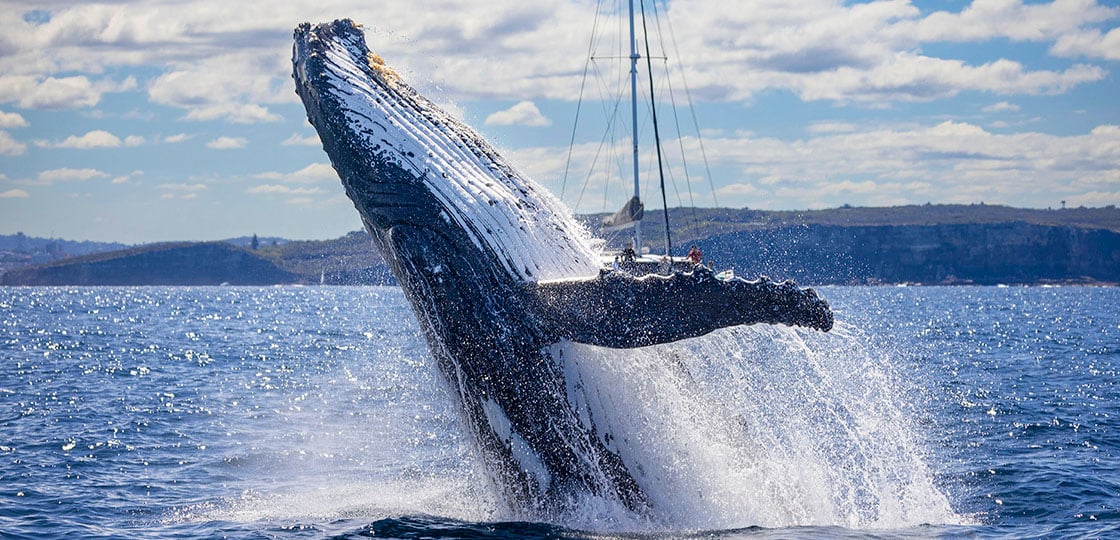
During Australia’s whale migration season, the risk of close encounters and collisions is increasing.
Quick overview
- Big numbers: it’s estimated that 50,000 to 60,000 whales migrate on Australia’s east coast, most within a 10km corridor.
- Heavy hitters: An adult humpback whale weighs around 40 tonnes. They tend to sleep just below the surface, out of sight.
- Warning systems: There is currently no fully proven and effective detection or deterrent technology.
Between May and November in Australia, it’s estimated that 50,000 to 60,000 whales travel the “humpback highway” along the east coast, the vast majority staying in a corridor within 10km offshore on their way to their tropical breeding grounds.
Also scheduled to take place during this period are two major offshore yacht races – the Sydney Gold Coast and Gold Coast Mackay Yacht Race.
As humpback numbers have recovered to pre-industrial whaling levels, the incidence of what’s termed ‘interactions’ between race boats and whales has also increased.
No Limit whale collision
The 2023 Brisbane Hamilton Island Yacht Race got underway on August 4. While it proved to be a fast downwind ride, severe collisions with whales forced at least two crews out of the race, led to multiple injuries, and caused serious damage requiring, in one case, months of repairs.
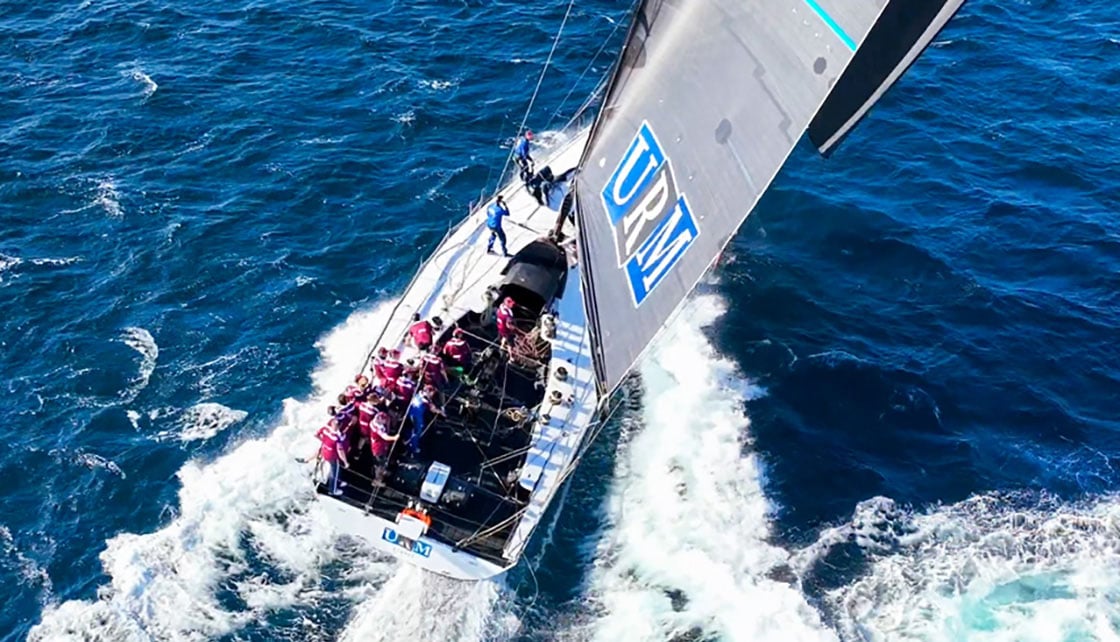
For the crew of No Limit, a Reichel Pugh 63, their race came to a jarring end in the middle of the night off K’gari (Fraser Island) as the boat was hitting speeds of 20 knots (37km/h).
“It felt like a car crash,” recalls skipper and owner David Gotze. “We were fortunate that the collision occurred when relatively few people were on deck and not in a more vulnerable position.” Gotze details the physics involved: “At 20 knots in a sudden collision lasting 0.1 seconds, an unrestrained occupant would experience a force of roughly 10G, which is enough to cause severe internal injuries or death.
“For a 75kg adult, the kinetic energy at that speed is approximately 4000kJ, meaning the adult would feel a force equivalent to 10 times their body weight.”
While there were no major injuries, there were plenty of minor fractures and bruises among the crew.
“We also had one more minor collision, presumably with a whale near Mackay, bringing the total number of strikes to four in three northbound races,” Gotze added.
Whisper damaged by whale
No Limit limped back to Mackay and was soon joined by another well-known race yacht and fellow competitor, Whisper owned by David Griffith.
“We were about 23 nautical miles [42.5km] off Rockhampton and at 8.30 in the morning, so it was perfect visibility,” Griffith recalls. “We were doing about 21 knots [38.9km/h] and not a whale to be seen. Then suddenly, bang, we stopped as if we’d run into a brick wall and people were flung everywhere.
“I was steering and was thrown against the wheel and damaged my ribs. Other crew members suffered a bloody head and concussion, broken bones, we almost lost someone overboard.”
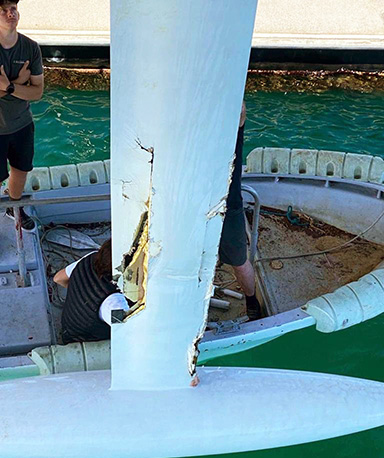
Griffith and his crew later discovered that a large section of the keel had splintered. The hull and mast had to be checked with ultrasound and the rigging sent to Sri Lanka to get checked.
Can you avoid hitting whales?
Considering an adult humpback whale measures up to 16m (52.5ft) and weighs around 40 tonnes, the incident prompted Griffith to research whale collisions with yachts and what might be done to avoid them.
“These humpbacks sleep a few metres underwater, so there’s absolutely nothing on the surface to indicate they’re there. It’s like hitting a reef,” he said.
Griffith began investigating devices known as ‘pingers’ that claim to deter whales by emitting signals of low frequency and variable volume. Pingers have been used for over a decade on fishing nets and ropes, and an Australian company, Future Oceans, is at the vanguard of the technology.
Just how effective they are is still under debate.
“The boat itself makes noise and for a whale the ocean is a loud place,” prominent whale researcher Dr Vanessa Pirotta explains. “There’s no magical tool that we have that’s going to help us avoid a collision … Both the whales and us are vulnerable to each other.”
Technology to deter whales
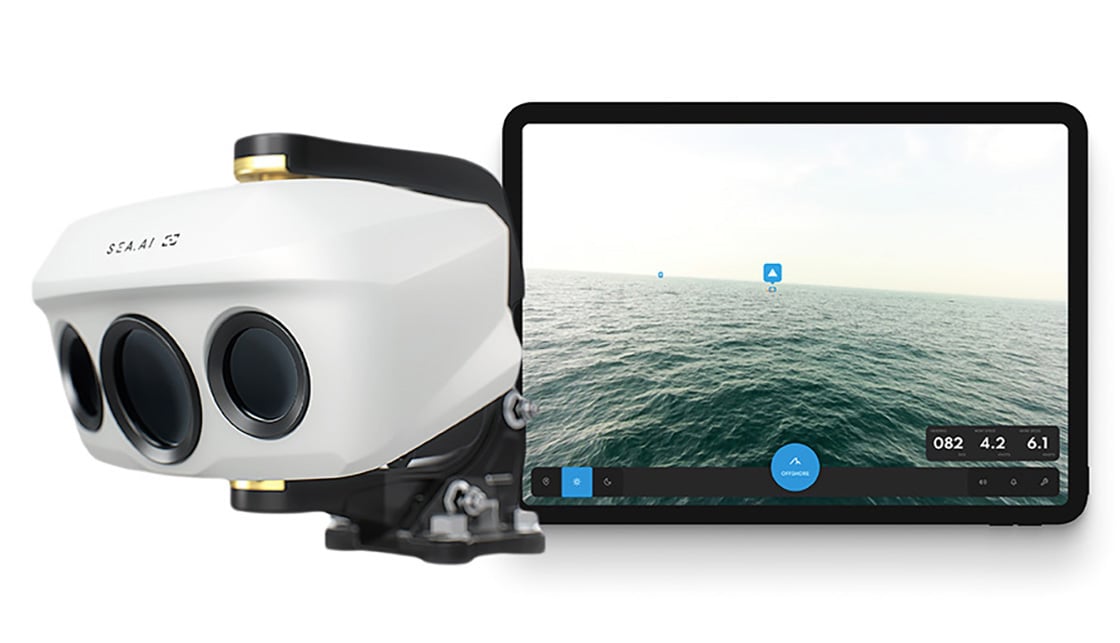
Other new technologies are being harnessed. For example, most IMOCA around-the-world racing yachts carry the masthead SEA.AI camera system (formerly OSCAR) that is designed to see potential hazards.
The technology reportedly has limitations with regards to high-speed yachts, where an alert may be issued too late to make a steering correction.
Other trials are underway using passive, ultra-sensitive underwater listening devices that detect the sonic clicking of whales in the vicinity and send an alert to shipping. Also, thermal imaging cameras that detect the heat signature of a whale when it breaches or exhales.
There is no official data showing the mortality rates for whales that are struck by commercial and recreational vessels, yet it’s likely they suffer significant, possibly life-threatening, injuries.
It means we absolutely have to find a way of ensuring that boats and crews can safely share the ocean with these inspiring sea creatures that totally deserve our respect and protection.
The full version of this article ran in the Apr-May (Volume 41.2) issue of Club Marine Magazine. Find out how you can subscribe to Australia’s leading marine lifestyle magazine here.
RELATED ARTICLES


Any advice here does not take into account your individual objectives, financial situation or needs. Terms, conditions, limits and exclusions apply. Before making a decision about Club Marine boat insurance, consider the Product Disclosure Statement (PDS)/Policy Document and Supplementary PDS (if applicable). Where applicable, the PDS/Policy Document, Supplementary PDS and Target Market Determination (TMD) for Club Marine boat insurance are available on this website. We do not provide any form of advice if you call us to enquire about or purchase a product.
Club Marine Limited (ABN 12 007 588 347), AFSL 236916 issues Club Marine boat insurance and handles and settles claims as agent for the insurer Allianz Australia Insurance Limited (ABN 15 000 122 850) AFSL 234708 (Allianz). Club Marine Limited is a related body corporate of Allianz. Copyright © 2026 Allianz Australia Limited.