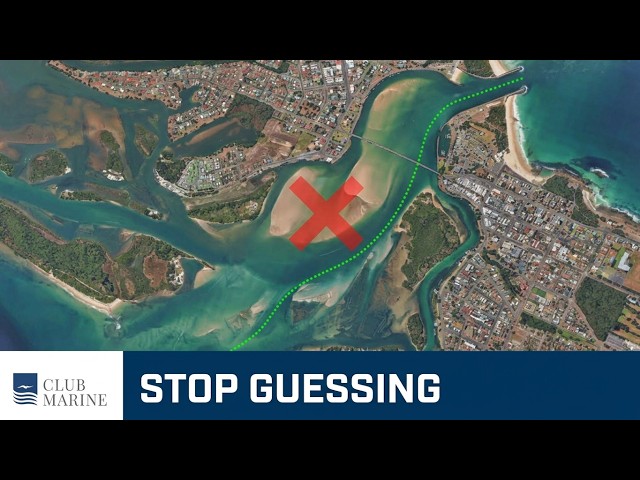
Whether you’ve towed your boat to a fresh holiday spot or you're exploring a new local waterway, starting from scratch can be daunting. In this video we share an essential guide to mastering unfamiliar waters with confidence.
Guide to boating in a new area
We all know the feeling. You've rocked up to a new place. The excitement is high. You've brought the boat.
But where do we start?
Good day and welcome back to Club Marine TV. It's Jono here and today I'm going to be discussing a topic that is very familiar to all of us. You've towed the boat to a new place, but you have no idea about where to fish, where to boat, where to swim, where to get a coffee. Now, the bad news is there's not one single answer that's going to get you out of trouble here. The good news is I've got a bunch of basic principles that we can implement together to make your time in a new waterway a good one. Now, believe it or not, one of the biggest tools you've got when you go to a new place has actually been in your pocket the whole time. Your smartphone.
Before you hitch up the boat, your phone does half the work for you. Put up the satellite view and marine chart of the place. Find the ramp, the main channels, the sand bars, and any marked hazards. And check the local tide and weather for that exact spot. The other bit of homework doesn't happen on a screen. It happens at the local tackle shop. Buy a few bits and pieces and ask what's biting, what they're biting on, and just as important, where it's safe to go boating. No one knows a spot like a local.
Now, don't think that you can rock up to a new waterway and understand it within a matter of hours. It's just not practical, and no one is expecting you to do that. What I encourage you to do is a recce or a reconnaissance mission, which is essentially getting a bit of a feel for the place. In my case, it's trolling around at a slow speed. I might have a lure out. I've got the polarised sunnies on. I'm looking at my electronics, my sounder, and I'm just trying to gather as much data as I can, looking out for other boats and birds to then inform me as to what I want to do that afternoon or the following day.
No two waterways in Australia are the same. Some are defined by big sand bars like this. Others up north are skinny creeks that wind and bend around big structures and rock bars. It's just not practical to come out here and nail it within the first couple of hours. So do a recce.
The good news is regardless of wherever you are in the country and what waterway that you're on, there are some general basic principles that you can apply which should be relevant no matter where you're boating. So what are those principles?
A handful of things hold true on almost any waterway in the country. Deep water tends to sit on the outside of a bend where the current cuts a channel and often along the edges of drop-offs or around channel markers. So, if you're ever unsure on where you can boat, follow that deeper line and stay clear of those areas where the sand builds up. Clean water usually comes in with the tide. It's at its clearest around the top of the tide when that fresh ocean water is pushing in. So, that's your window for a swim or for spotting fish on the flats. And the water movement tells you a lot. It speeds up and funnels through narrow points and around structure. So if you see a back eddy or fast-moving water, slow down because it usually means there is some type of structure in the area.
So if we take those general principles and we now apply them to a fishing perspective, I've got good news. No matter where you are in the country, if you're chasing bass, trout, barramundi, snapper, all fish need structure. So it doesn't matter where you are. If you can find some structure, some fish-holding areas, I promise you, it doesn't matter what system you're in, you'll have some type of success. So if you've rocked up to a new place, if you can find a drop-off, a rock bar, a back eddy, a pressure point, a funnel for the tide to go through, some birds working, bait schools, whatever the case may be, you can find those areas. And it doesn't matter if you're in the top end, on the central coast, or down south. Fish won't be too far away. And that's what I'd be looking for when you go out fishing.
Take this session for example. Jack and I, my mate, were fishing up in northern Queensland, a long way from home for me. Yet, we worked out where the fish were holding using these basic principles. We found them on a creek mouth right near structure where water was flowing out. That isn't luck. That was us applying these principles.
I haven't asked Jack where they're sitting, but I reckon they're going to be sitting on that point. It looks like a really good little vantage point.
Oh, you've gone for the water cast. I usually go the mud-skipping cast where it hits the mud first because they are feeding right on the edge.
Yeah. Okay. Well, I might do that now because that cast didn't work. That's right.
So, I'll go. You reckon? Hit it up on the mud.
Land it on the mud and then just slide it in. Ready on the mud. Back in the water.
Yeah. Yes. Got him on the light gear. Very light gear.
Oh, that's cool. That's actually really cool. Hit it on the mud and they're sucking it as soon as it drops in.
This is proper light gear now, which makes this so much more enjoyable. Make him jump for the camera. I'm on the board. Get in there.
What a catch. There you go, mate.
Oh, come here. Let me hold one of these things. There you go, mate. Now we're talking.
Now we're talking. It's so much fun.
Doesn't matter how big they are. We know how - Oh, they're still both in. They're both commissioned to cast.
Now, I mentioned all the data we have at our fingertips with our smartphone. But one of the biggest hacks that I've got for you is using these, your sonar unit or your sounder. Doesn't matter what brand or style you've got. There's a function in here, particular on this brand. I've got a Lowrance unit called Genesis Maps. You can find it in chart options and all the different brands will call it something similar. But this is one of the biggest hacks that I've got for you when fishing a new place.
Genesis Maps is data that is uploaded by other boat users in the area. They're social maps. So, by clicking the Genesis map option, straight away, we're given so much data on this particular waterway, which has been informed by other people with this unit. I just think that is such an underrated tool.
So, when I get to a place like this, turn on the Genesis Maps and look at all the data we have - drop-offs, structures, high points, low points, contours, ridges - all this is at our disposal now to go fish. So, if you get to a new place and you have no idea where to start, no idea where to make that first cast, turn on your sounder, go to the mapping system, and find the social maps. That'll give you a pretty good place to begin your session.
So, if you do your homework, do your research, you chat to the locals, you slow down when you're out on the water for the first time, and you just think about those core basic principles, I promise you, being on new waterways like this are going to be far less intimidating.
RELATED VIDEOS




Any advice here does not take into account your individual objectives, financial situation or needs. Terms, conditions, limits and exclusions apply. Before making a decision about Club Marine boat insurance, consider the Product Disclosure Statement (PDS)/Policy Document and Supplementary PDS (if applicable). Where applicable, the PDS/Policy Document, Supplementary PDS and Target Market Determination (TMD) for Club Marine boat insurance are available on this website. We do not provide any form of advice if you call us to enquire about or purchase a product.
Club Marine Limited (ABN 12 007 588 347), AFSL 236916 issues Club Marine boat insurance and handles and settles claims as agent for the insurer Allianz Australia Insurance Limited (ABN 15 000 122 850) AFSL 234708 (Allianz). Club Marine Limited is a related body corporate of Allianz. Copyright © 2026 Allianz Australia Limited.