
Turn your boat-buying experience from potluck into a pot of gold by knowing which motors to consider.
Quick overview
- Oldies but goodies: Some two-stroke outboards remain simple and reliable
- Resale value: Buy the newest technology and most recent motor you can afford
- Back-up service: It may be better to buy the boat at an authorised dealer
- Patience rewarded: Be prepared to walk away until the right outboard comes up
When you finally decide to treat yourself to that second-hand runabout, don’t forget to factor the outboard into the equation. In this article, we’ll look at what motors you should or possibly shouldn’t buy.
Personally, I wouldn’t dismiss a boat with a conventional two-stroke outboard, as the technology is tried and proven. True, they’re a little dirty in that unburnt charge exits the cylinder on the exhaust stroke – and also they require high-quality oil mixed with the fuel – but these engines have been around for decades and improvements were made with each new model.
If you’re interested in a boat from the mid-1990s to, say, 2005, there’s a good chance it’ll have a late-model (probably carburetted) two-stroke on it. If serviced regularly and properly, motors from that era will still be in their prime.
While some two-strokes might have an issue with low cylinder compression, this is not necessarily so. What’s more important, regardless of how low overall compression may seem, is that all cylinders are within 10psi (69kPa) of each other. Get this checked by a professional as part of your pre-purchase inspection.
The pick of two-stroke outboards
You really can’t go wrong with a two-stroke Yamaha from the late 1990s right up until they were withdrawn from the Australian market in 2019. I would rate the three-cylinder 40/50, 60/70 and 90A, the V4 115/130, and the V6 150/175/200 as the marine equivalents of a Toyota HiLux.
I’d also have no issues with the last of the carburetted Johnson motors (60 to 150hp), although the V4/V6 models were thirsty and suffered from magneto/stator issues, which were remedied with newer models. However, if the boat is priced accordingly, it might be okay to take a chance.
Ditto for all carburetted 140 to 225hp V6 Mercury/Mariners – immensely reliable, even with the remote, boat-mounted oil tank. And the Tohatsu-sourced 15 to 50hp Mercury/Mariner models are virtually indestructible.
Suzuki and Tohatsu are both okay, although neither brand sold in great numbers, and the two-stroke Suzukis of the late ’90s didn’t always fare well in the corrosion-resistance stakes. A boat with either of these brands from that era should be priced compellingly.
Direct-injection two-strokes
I call this the twilight zone – the early years of lean emission, when the major manufacturers (Yamaha and Mercury) had to decide on whether to proceed with cleaned-up direct injection (DI) two-strokes or go all-in on four-strokes.
In terms of durability, reliability and ease of resale, I believe it’s hard to go past the V6 2.6lt Yamaha HPDI series (150/175/200hp). Considering this series of motors was a quickly conceived concept to compete with the Evinrude and Mercury DI motors of the era, they turned out to be some of the best engines Yamaha ever made.
In that era, both Mercury and Tohatsu licensed and utilised Ralph Sarich’s Orbital technology for two-strokes, which involved the use of a large-volume, belt-driven air pump to force air into the motor.
Mercury took the high-pressure route under the Optimax label, while Tohatsu’s iteration was low-pressure and dubbed TLDI (Two-stroke Low-pressure Direct Injection). The 40 to 115hp Tohatsus were reliable, but very few were sold.
Mercury used Optimax from 75 to 250hp and although it was a noisy system (especially the air pump), its reliability wasn’t bad.
Which leaves Evinrude E-TEC. They weren’t bad as such, but relatively complex and arguably had too much electronic trickery for their own good. The G2 models were manufactured until the demise of the brand in 2020.
That being said, I would not rule out a boat with an E-TEC motor if the pricing reflected the obsolescence of the motor. If you buy with a view to eventually replace the motor, you should be okay.
Fab four-strokes
I marvel at the fact that the outboard industry tackled the issue of emissions in under two decades, whereas it took the automotive industry almost double that time.
It would be unfair to recommend any one particular brand, as each has always produced its own star performers in certain categories, but there are some standouts that will lift the desirability of a used boat.
Among these would be the Yamaha F150 (which changed the whole game when introduced in 2004), the Yamaha F70, the latest Suzuki DF140B, the Suzuki DF90A/100B, and the Mercury 75/90/115 and 150.
This is far from a definitive list, but used boats equipped with these motors tend not to linger in dealers’ yards or the classifieds.
Buy the latest outboard tech you can afford
Naturally, it’s best to buy the newest technology and most recent motor you can afford – even if it means opting for a smaller motor. If a few more dollars will get you into a four-stroke instead of a DI two-stroke, that’s the way to go.
Beware, some of the first-generation four-strokes displayed a condition known as dry-exhaust corrosion, which basically meant that because no unburnt fuel or oil was being exhausted from the motor, high-sulphur petrol could actually erode or burn through some of the surfaces in the exhaust area.
No amount of freshwater flushing could deal with this phenomenon, as it was completely unrelated to contact with saltwater. However, this will have been resolved by now on any models that were afflicted.
Other than this early foible, I would most resolutely have four-stroke set as a default position on my desirability radar. If you like a boat but it doesn’t have a four-stroke motor, bargain hard and be prepared to walk away until the right one comes up.
Buying through an outboard dealer
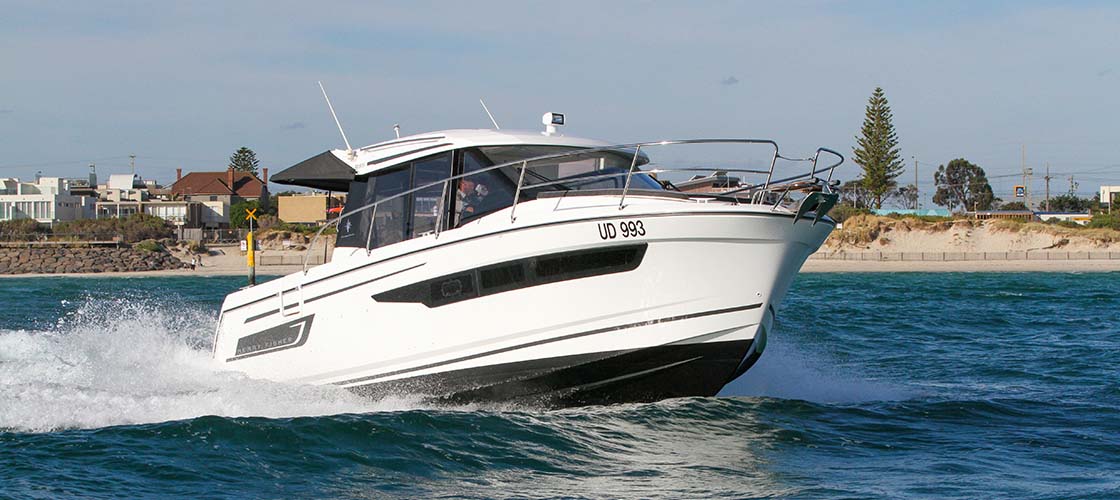
Buying a used boat and motor is a lottery, so it may be better to buy the boat at an authorised dealer, even if it costs a tad more. A dealer will have the service history and insight into hours run and at what rpm etc, and they may even provide a warranty as well as any balance of the motor’s factory warranty.

Want award-winning boat insurance?
RELATED ARTICLES


Any advice here does not take into account your individual objectives, financial situation or needs. Terms, conditions, limits and exclusions apply. Before making a decision about Club Marine boat insurance, consider the Product Disclosure Statement (PDS)/Policy Document and Supplementary PDS (if applicable). Where applicable, the PDS/Policy Document, Supplementary PDS and Target Market Determination (TMD) for Club Marine boat insurance are available on this website. We do not provide any form of advice if you call us to enquire about or purchase a product.
Club Marine Limited (ABN 12 007 588 347), AFSL 236916 issues Club Marine boat insurance and handles and settles claims as agent for the insurer Allianz Australia Insurance Limited (ABN 15 000 122 850) AFSL 234708 (Allianz). Club Marine Limited is a related body corporate of Allianz. Copyright © 2026 Allianz Australia Limited.