
Here’s how to turn a basic open tinnie into an efficient fishing machine.
Quick overview
- Be prepared: Plan your wiring loom to be neat and easy to fix.
- Starting power: Your outboard battery has one job to do.
- Seeing is believing: Live sonar technology is a game-changer
- Must-have: A trolling motor is a tinnie’s best friend
Every trailerboat owner knows the feeling when you do a lap of the ramp carpark and check out the other rigs. Some look like they rolled straight off the dealer’s floor, others look like a tackle store and a 4WD accessory shop had a baby. The latter is what we’re chasing here.
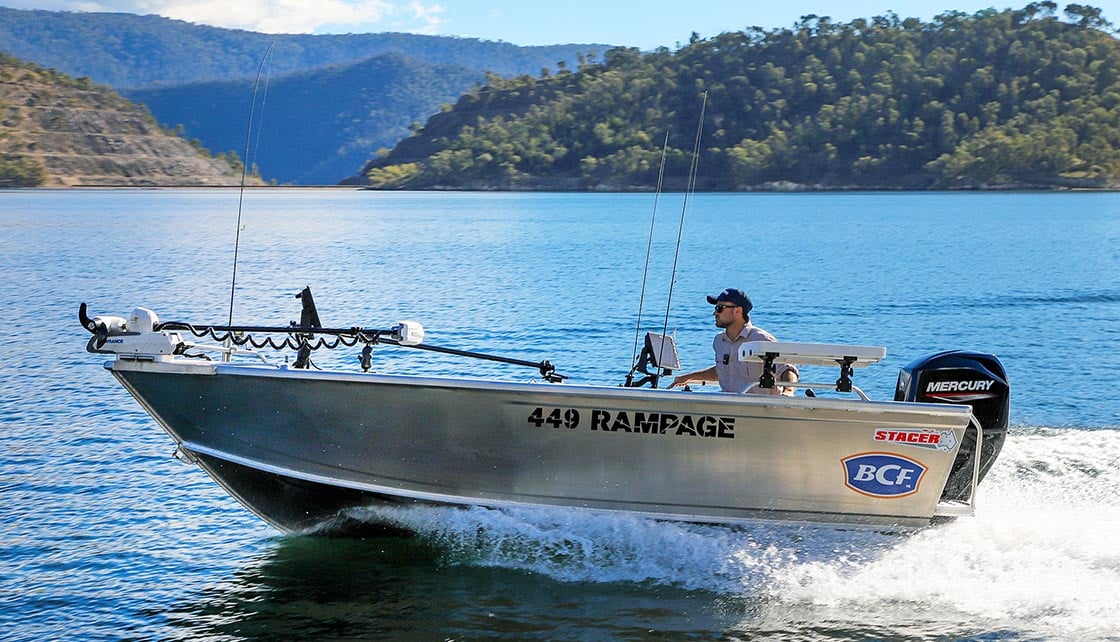
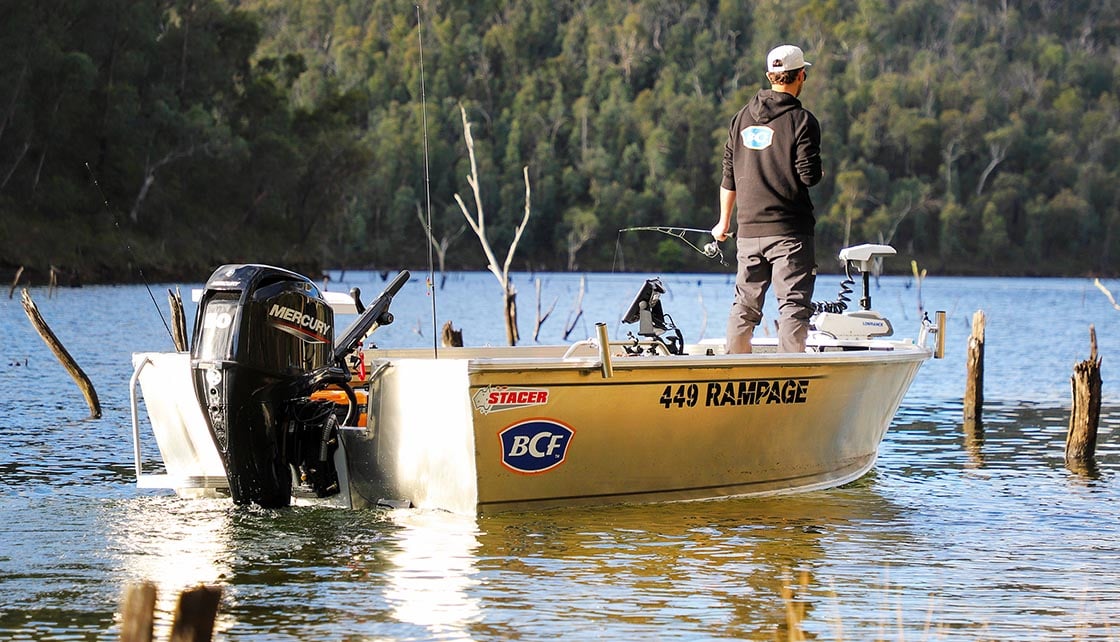
Recently, I picked up a new Stacer 449 Rampage as a bare hull, an outboard, and not much else. The plan, though, was to turn it into a proper fishing machine to chase impoundment bass at first light, slide quietly into a snag for a barra, and chuck deep-divers at a gold-painted Murray cod.
Here’s how I went about it, what I bolted on, and why.
Where to start with a tinnie fitout
Before we get into the gear list, a quick note on the build approach. I could’ve gone full NASA on this rig – distributed CAN-bus this, integrated touchscreen-everything that, every accessory talking to every other accessory. But instead I went deliberately simple.
Each subsystem is its own loop. The cranking battery does its job, the 24V lithium bank does its too. Each screen, sounder module, and light has its own clearly labelled wire run, its own fuse, and its own breaker where it matters. Bus bars where they make sense and terminal blocks where they don’t – and a single sheet of paper in the glovebox that maps it all.
The reason is fault-finding. When something fails on the water, usually at 5am, I want to be able to chase the problem easily. Bells and whistles, absolutely. Black-box wiring spaghetti, no thanks.
Simple is faster to fix and easier to upgrade, and simple lets you keep fishing.
More fuel, more range
The factory tank in a 4.4m boat is fine for a quick session. It is not fine for a 40km run up the back of an impoundment or a winter snapper session.
I swapped the standard 14lt tank for a 30lt unit. More litres equals more fishing time and less time second-guessing every throttle position. Worth every cent.
Cranking battery and 24v lithium on my tinnie
Power is where modern fishing builds either fly or fall apart. I split the system into two clear jobs it had to do.
Job one: start the outboard and run the basics. That’s a dedicated cranking battery, mounted in its own box, on its own circuit, charged by the outboard. No matter how I run my electronics, the motor still turns over at day’s end.
Job two: feed the toys. The Recon trolling motor is a 24V unit and the live sonar set-up pulls real current. So I built a 24V, 100Ah lithium bank to handle the trolling motor, the bow-mounted sounder, and the ATIIXL transducer module.
Live sonar technology
If you haven’t had a session on live sonar, prepare to have your world view rearranged. Lowrance ActiveTarget 2 XL puts a real-time picture of the fish, the structure and the bait on your screen. You’re casting at fish you can literally see swimming.
I mounted my module in the front compartment with a custom bracket. The transducer goes either on the trolling motor shaft or a separate pole, which I will use, and connects back to the module, which then talks to the main Lowrance unit at the helm.
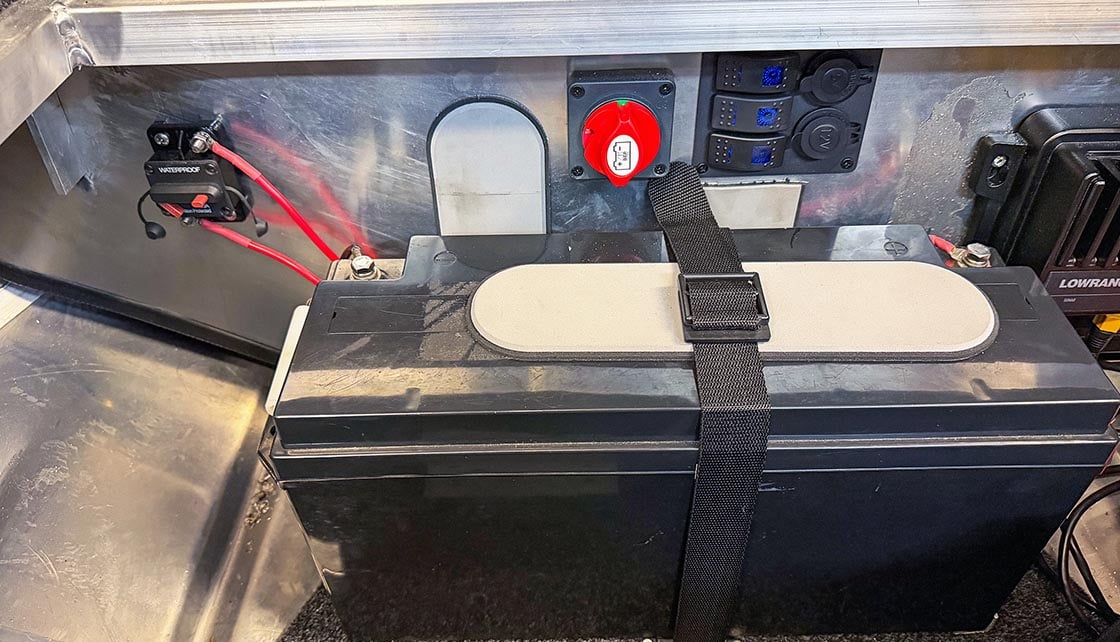
Image: Cranking battery mounted in box
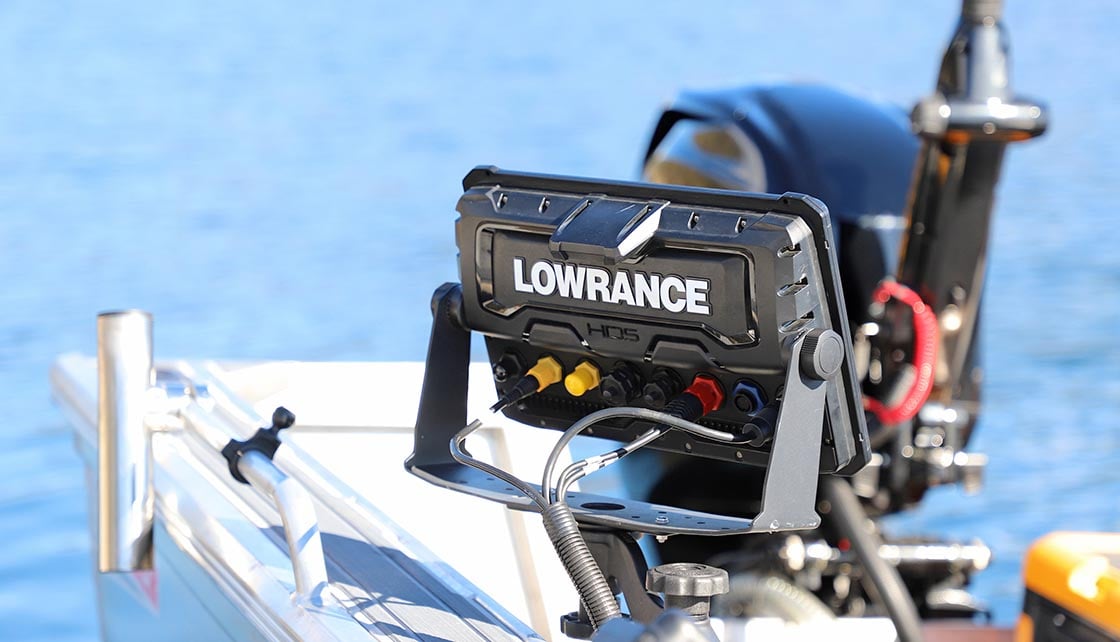
Image: Lowrance ActiveTarget 2 XL
Tinnie trolling motor installation
The Lowrance Recon trolling motor is the heartbeat of this build, with Anchor-Lock, auto-routing, integrated sonar, and smooth deployment.
The standard mounting plate footprints are designed for fibreglass bow decks, so I fabricated a low-profile electric motor bracket that bolts through the bow section and ties down to a backing plate underneath. It spreads the load, sits flush when stowed, and doesn’t catch a fly line on a back cast.
Wiring runs back along the portside gunwale inside split-loom, terminating at the 24V lithium bank with a properly rated breaker.
Why you need a DC-DC converter
The Lowrance HDS units, the ActiveTarget 2 module and the bow sounder are all 12V accessories, but the Recon trolling motor is 24V. That means the lithium bank powering the front of the boat is 24V as well.
Twenty-four volts going into a 12V accessory equals one expensive cloud of smoke, unless you fit a DC-DC converter. It’s a step-down unit that takes the 24V from the lithium bank and outputs clean, regulated 12V to the accessories.
Pick one with plenty of amperage headroom for everything you’re going to plug in. Fuse the input side properly, and mount it somewhere with airflow because they can heat up under load.
As mentioned, don’t be tempted to feed the 12V accessories straight off the cranking battery. Plan the converter into your build from day one.
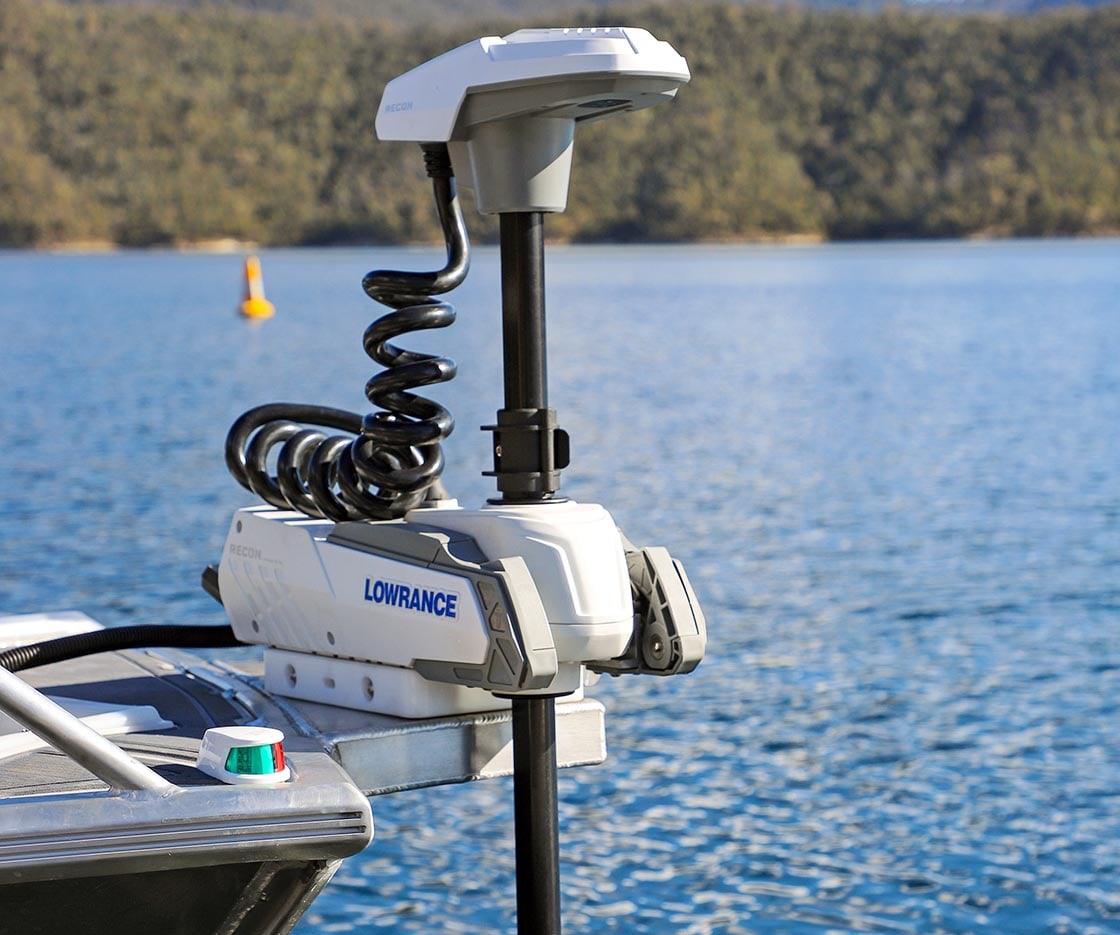
Image: Lowrance Recon trolling motor
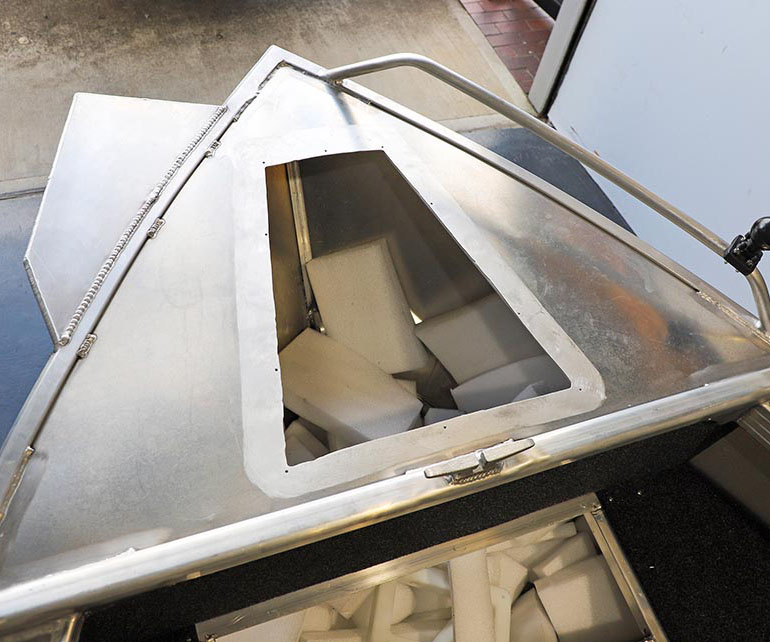
Image: Bow storage
Decking out the cockpit
This was the upgrade my back didn’t know it needed. SeaDek is a closed-cell EVA foam product, cut to fit, with a peel-and-stick backing. I had mine cut for the gunwales and the front seat.
Three things changed immediately:
- Grip: wet feet on a rocking deck no longer feels like ice skating
- Sound: the hull noise on a tinnie is significantly reduced, especially when you bump a rod butt or drop a sinker
- Aesthetics: the boat went from tradie-cool to tournament-clean in an afternoon.
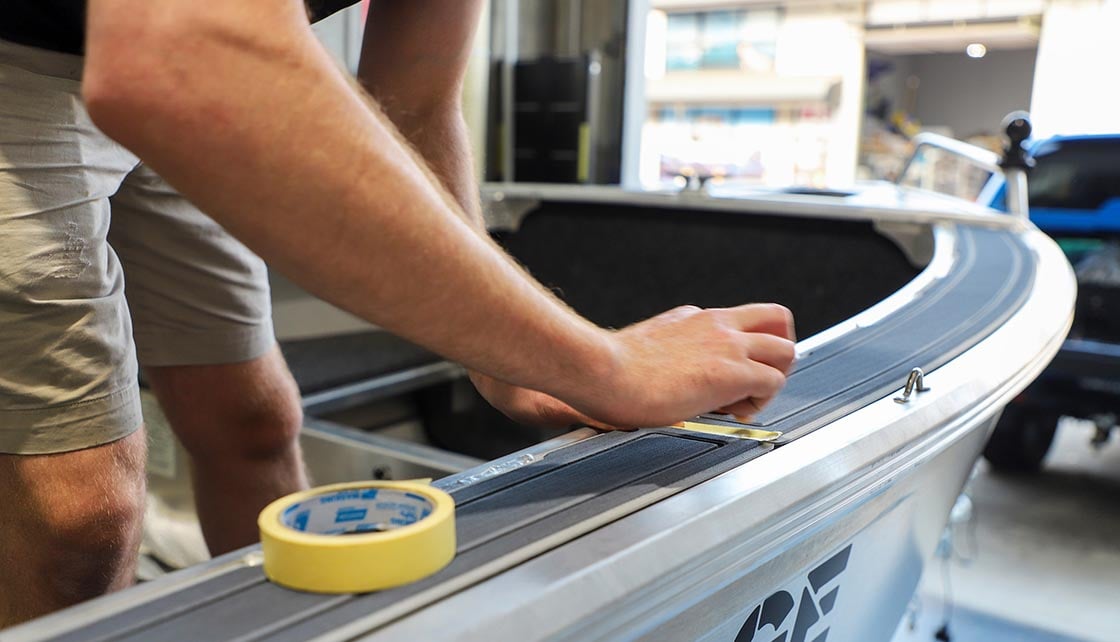
Image: SeaDek apply to gunwales
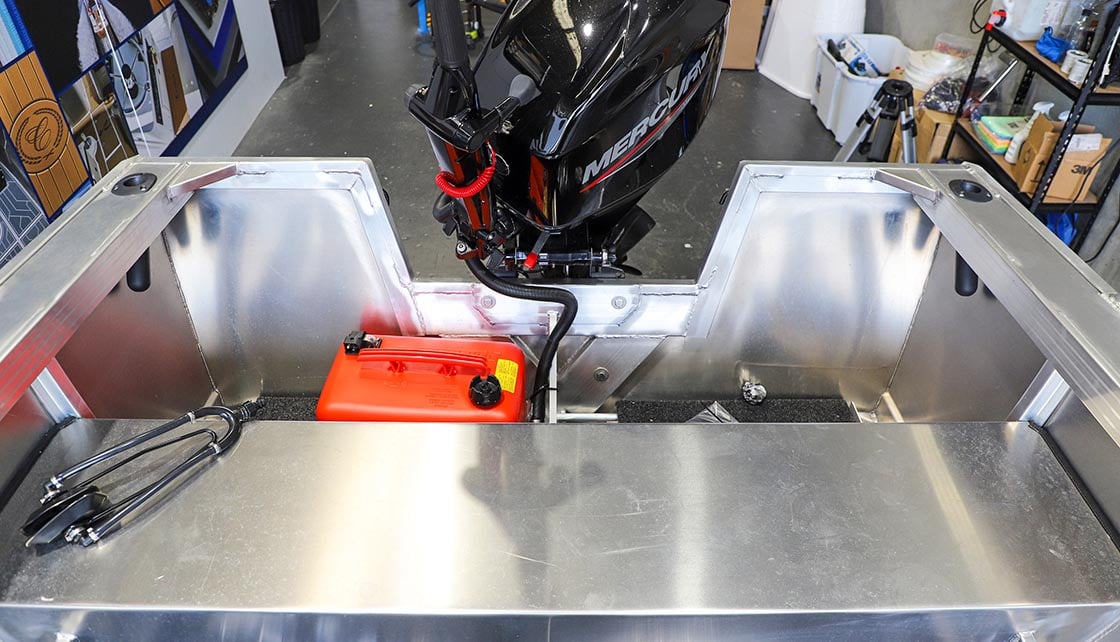
Image: Fishing gear storage
Layout for fishing
Tackle storage and rod organisation is what separates a tidy session from a tangled one. I went with a combination of vertical rod tubes mounted along the inside of the gunwales for fast-access rods, and rocket launcher-style holders on the bait board frame for trolling and standby outfits.
The bait board sits over the transom, doubles as a workspace, and clears the cockpit floor of bait gear. And rodholders that double as cupholders are not a gimmick.
If I take a step back from this build, the thing that strikes me most is how much of it is just decisions. The hull was always going to be the hull, but everything else – the power system, the electronics, the layout, the look – was a string of small choices about how I wanted to fish.
That’s the part nobody can do for you.
Make yours the build that makes you want to launch on a Tuesday after work and lets you fish the way you want to fish.
The full version of this article ran in the June-July (Volume 41.3) issue of Club Marine Magazine. Find out how you can subscribe to Australia’s leading marine lifestyle magazine here.

Want award-winning boat insurance?
RELATED ARTICLES
Any advice here does not take into account your individual objectives, financial situation or needs. Terms, conditions, limits and exclusions apply. Before making a decision about Club Marine boat insurance, consider the Product Disclosure Statement (PDS)/Policy Document and Supplementary PDS (if applicable). Where applicable, the PDS/Policy Document, Supplementary PDS and Target Market Determination (TMD) for Club Marine boat insurance are available on this website. We do not provide any form of advice if you call us to enquire about or purchase a product.
Club Marine Limited (ABN 12 007 588 347), AFSL 236916 issues Club Marine boat insurance and handles and settles claims as agent for the insurer Allianz Australia Insurance Limited (ABN 15 000 122 850) AFSL 234708 (Allianz). Club Marine Limited is a related body corporate of Allianz. Copyright © 2026 Allianz Australia Limited.