Marine radio 101

Chris Bell

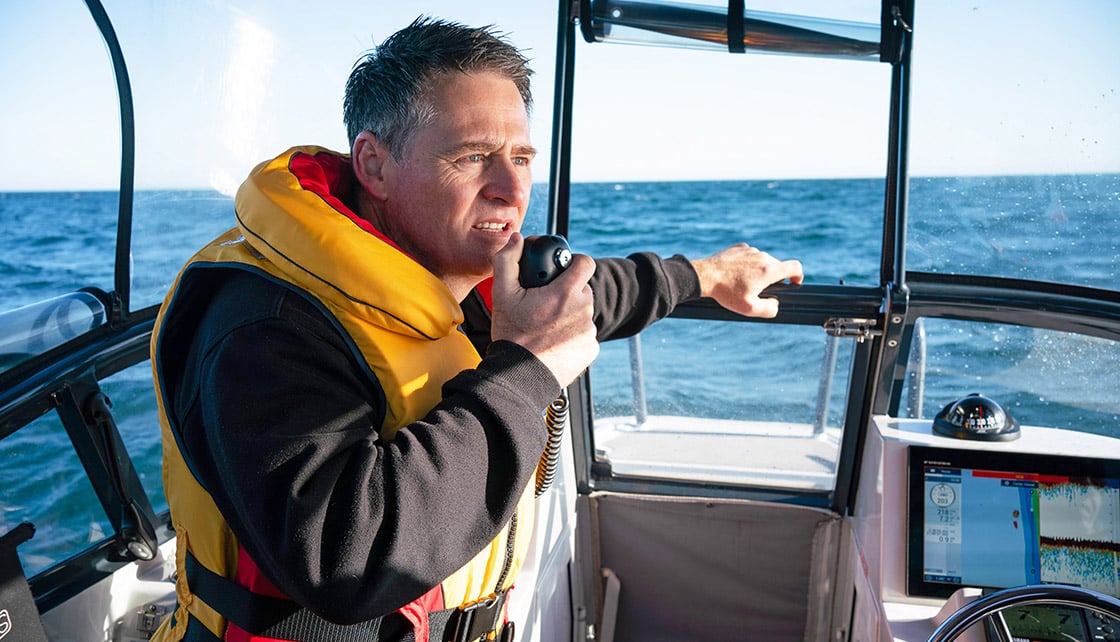
There’s a ship headed your way and your engine just died, rendering you a sitting duck on a perilous path. You pocket your phone and grab your VHF radio instead, put out a call on Channel 16 asking for sea room, and moments later see the vessel divert around you to disappear over the horizon.

Perhaps your phone just lost coverage and there’s no other way to hail your buddy (or another boat) except by picking up the VHF. It might be your emergency, or one playing out in your anchorage, but you’ll never be able to reach out unless your VHF is up and running.

The simple truth is that when it comes to communicating at sea, a mobile phone can really let you down. Even when you’re able to make a phone call, you’ve reached just one person – your VHF calls everybody in range, instantly and all at once.

Just say “mayday” over VHF and you’ll muster immediate help, transmitting your plea in every direction – independent of mobile phone towers and coverage – and without even thinking about who you need to call and on what phone number.

The fact that all commercial vessels and plenty of recreational boaters keep a listening watch on their marine radios affords boaters enormous peace of mind. And since VHF repeater stations onshore are always located on high ground, offering a nominal range of 80km or more, they trump phone coverage every time.

Another thing in your radio’s favour is that search and rescue forces can easily home in on marine radio transmissions, and with a DSC (Digital Selective Calling) enabled radio, you can instantly transmit your precise location and emergency at the push of a button – all without uttering a single word.

Essentially, radio frequency waves travel through the atmosphere at the speed of light, and their different wavelengths – long or short – determine their radio frequency that you tune into by switching channels on your radio.

Some radio waves, such as those in the VHF bandwidth, travel in a straight line. Through the ionosphere and out into space they go, leaving just the ground wave segment for us to receive. It’s because of this straight-shooting and the earth’s curvature that VHF radio frequencies have a limited range.

Longer wavelengths, such as those in the high frequency (HF) bandwidth, can refract within different layers of the ionosphere, return to earth at a point well over the horizon and continue to make leaps on and off the earth’s surface like a giant skipping over the globe. This makes HF waves capable of communication over thousands of miles.

So how does all this relate to the average boater like you and me? Of the three types of marine radios, VHF (very high frequency) radio sets are the norm. Far less common are old-school MF/HF (medium frequency/high frequency) radio sets, and the largely defunct 27MHz units.

You may also have heard of UHF (ultra high frequency) radio, whose limited range and power relegates their use to truck drivers, caravanners or, in a marine environment, for crew-to-crew communications aboard large ships.


27MHz radios provided a cheap and licence-free means of short-range communication but today they’re practically redundant. Not only is this radio obsolete aboard commercial (and most recreational) vessels, there’s minimal monitoring among coast stations and volunteer marine rescue organisations too.

Tasmanian and Northern Territory maritime radio operators don’t monitor the frequency at all, and if you are a Victorian and required to carry a marine radio by law, it can no longer be a 27MHz unit.

As such, the chances of anyone hearing you on this radio are slim, especially on a weekday or at long range. If you have one and have to use it, channel 88 (27.88MHz) will be highlighted in red on the channel selector as being the one to use for distress calling.

VHF refers to the frequency range between 156 and 162MHz. For ease of use, these frequencies are divided up into numbers  – such as the distress and calling Channel 16 – because different channels are used for different purposes.

For reliable coastal coverage, you can’t beat VHF. It’s monitored by all commercial vessels, volunteer marine rescue groups and official coast stations, and has dedicated repeater stations mounted on coastal high points and towers along vast areas of our coastline.

VHF also enables you to communicate with specific vessels in your area equipped with a Maritime Mobile Service Identity number (MMSI).

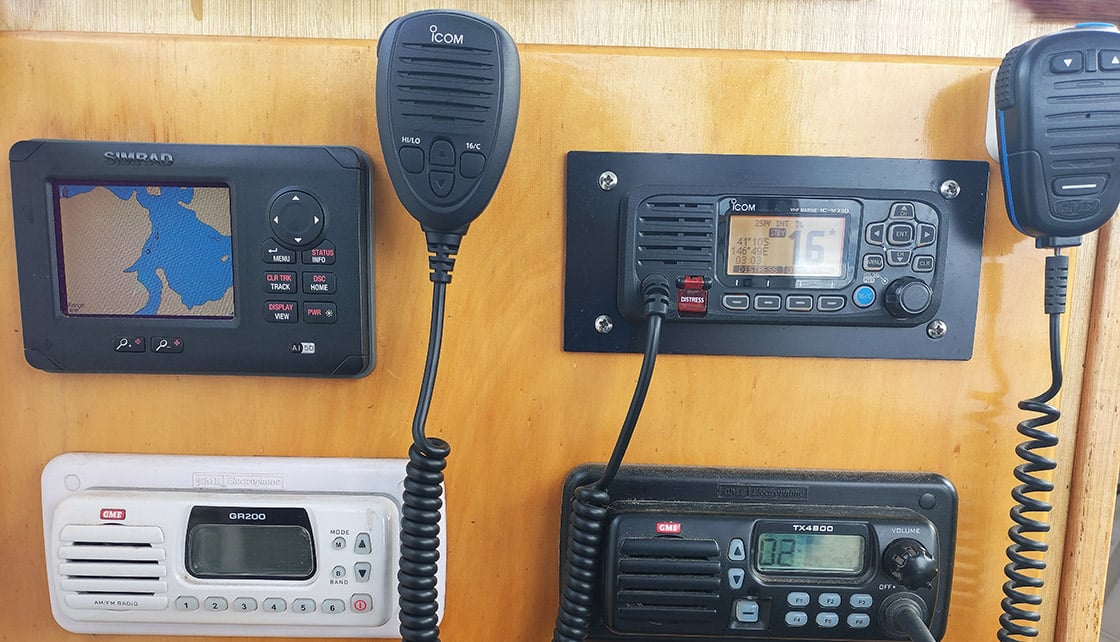
A new model VHF radio can be interfaced with other wheelhouse equipment, but the most important of these is your Global Navigation Satellite System (GNSS) receiver – allowing your distress message and your precise location to be transmitted at the push of a button.

GNSS is essentially the ramped up, more reliable version of GPS and accesses more satellites for greater accuracy.

VHF units mounted on your boat – as opposed to handheld – give you a choice of transmission strength, either using just one watt of power for close-range communications, or a maximum of 25 watts for distress or routine communication over longer ranges.

Several years ago, a story emerged of an elderly couple who were returning to their anchored yacht in a coastal bay. They were rowing their inflatable tender in a brisk offshore breeze, and sadly were never seen again. Presumably the wind swept them past their yacht into the vast ocean beyond.

It has motivated me to keep a handheld VHF radio fully charged and ready in my tender. A PLB, or personal locator beacon, would provide a further means to beckon help.

Handheld VHF units are conveniently compact, usually waterproof and affordable. They might have less transmitting power and less range than a unit you’d mount on your vessel, but the earth’s curvature won’t limit communications with airborne search and rescue resources when you’re transmitting from your dinghy or life raft.

For those crossing oceans and country borders in years gone by, a DSC-enabled MF/HF radio unit facilitated long-range communication and allowed you to receive weather reports over enormous ranges at sea.

Then satellites were sent into orbit, paving the way for a new phase of marine communicators, phones and now Starlink, and signalling the decline in the popularity, use and monitoring of HF radios.

Part of the ease with which sailors have dropped their interest in HF radios can be attributed to the skills needed to use one. An understanding of radio wave propagation and atmospheric ‘skip’ between day and night is de rigueur as, unlike VHF, HF channel selection depends on atmospheric conditions. 

As a general rule, the higher the sun, the higher the frequency that is needed to achieve a desired range for transmission.

The Australian Maritime Safety Authority (AMSA) maintains a 24-hour listening watch on all five HF distress frequencies, and some coastal stations monitor distress frequencies between 4 and 8MHz. But overall, the MF (medium frequency) part of this radio is not well monitored on the traditional distress frequency of 2182MHz.

Furthermore, the Bureau of Meteorology (BOM)  broadcasts high seas and coastal weather forecasts from AMSA’s HF transmitters in Charleville QLD and Wiluna in WA. The Joint Rescue Coordination Centre (JRCC) regularly broadcasts navigational warnings as well.

The majority of new VHF radios on the market today are DSC (digital selective calling) equipped. DSC allows you to call other vessels using their MMSI number (we’ll get to that soon) without needing to voice call, and allows for express distress calling at the press of a button.

Hit your radio’s DSC all-important red button and you instantly transmit the nature of your emergency and, if your radio is integrated to your GNSS, your location too.

While there is no official VHF shore-based infrastructure for DSC, the alert you send will still be received by any other DSC-equipped VHF radio, including those on commercial vessels.

AMSA’s two Maritime Communication Stations at Wiluna and Charleville will receive it too, as they maintain a formal, automated 24-hour DSC listening watch on all HF distress and calling frequencies.

When AMSA receives a DSC alert, an operator follows up immediately on the associated voice channel, already knowing your vessel details and, if your radio is interfaced with your GNSS, your exact position as well.

If your VHF or a MF/HF radio is equipped with DSC and you want to be able to use it, you will need a Maritime Mobile Service Identity (MMSI).

This is basically a unique, nine-digit phone number specific to your vessel’s radio that contains digital information about you, your contacts, your vessel’s registration and more.

Aside from enabling instant distress alerts to be sent at the push of a button, having a MMSI number means that you can communicate with other vessels directly, without needing to voice call. An audible alert will sound on the receiver’s radio, alerting them to your identity and the nature of your call.

Everyone who uses a VHF or MF/HF radio must have a licence, or be under the direct supervision of someone who does. For VHF operators, that means studying for and obtaining a SROCP – a Short Range Operator Certificate of Proficiency  – or the long-range operator version if operating a MF/HF set.

Courses are provided by the Australian Maritime College (amc.edu.au) and others. They’re an easy way to become familiar with your radio’s operation and gain the confidence to use it.

Global satellite communications company Iridium’s newest development is the world’s only truly global GMDSS (Global Maritime Distress and Safety System) compliant unit.

Essentially, these units give you reliable, pole-to-pole satellite coverage to send distress calls and communicate with rescue teams regardless of where in the world you are. Additionally, the Iridium SafetyCast provides navigational and weather information and facilitates general communications.

Since July 2023, AMSA and the BOM have delivered marine forecasts, weather and navigational warnings, and operational search and rescue related information via Iridium SafetyCast.

Give us a call on 1300 00 CLUB (2582)
Any discounts offered are applied to our standard rates. Promotional or other discounts may apply from time to time. Minimum premiums may apply. Any discounts/entitlements only apply to the extent any minimum premium is not reached. Where discounts are applied, your premium is subject to rounding. If you are eligible for more than one, we also apply each of them in a predetermined order to the premium (excluding taxes and government charges) as reduced by any prior applied discounts/entitlements.

Any advice here does not take into account your individual objectives, financial situation or needs. Terms, conditions, limits and exclusions apply. Before making a decision about Club Marine boat insurance, consider the Product Disclosure Statement (PDS)/Policy Document and Supplementary PDS (if applicable). Where applicable, the PDS/Policy Document, Supplementary PDS and Target Market Determination (TMD) for Club Marine boat insurance are available on this website. We do not provide any form of advice if you call us to enquire about or purchase a product.

Club Marine Limited (ABN 12 007 588 347), AFSL 236916 issues Club Marine boat insurance and handles and settles claims as agent for the insurer Allianz Australia Insurance Limited (ABN 15 000 122 850) AFSL 234708 (Allianz). Club Marine Limited is a related body corporate of Allianz. Copyright © 2026 Allianz Australia Limited.