Laws for boat navigation lights

By law, all vessels, whether at anchor or underway, must show navigation lights between sunset and sunrise and in restricted visibility such as fog, smoke or glare.

Navigation lights give information about the boat’s size, whether it’s underway or at anchor, its direction of travel, and the angle you’re seeing them at. It’s important that boaters have the right lights on their own vessel, switch them on when required, and understand what they mean.

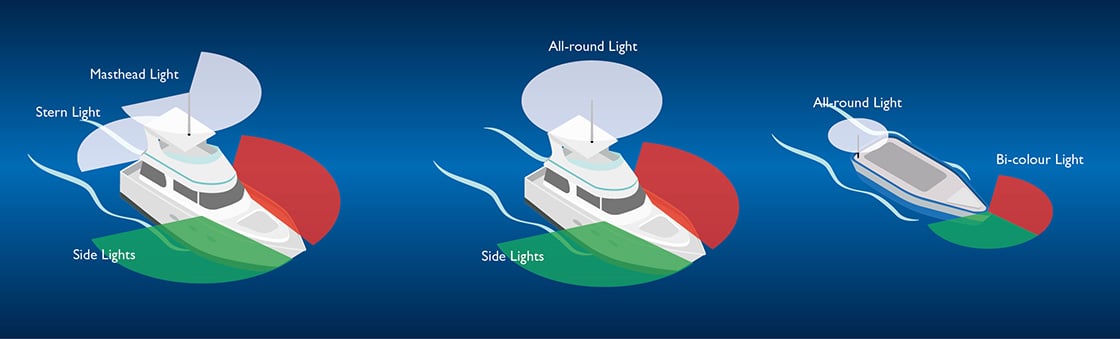
Red for port and green for starboard, mounted separately on their respective sides, or as a single bicolour unit on the bow. Sidelights shine from dead ahead to 112.5 degrees aft. Minimum range: visible from 1nm away (2nm for boats sized 12 to 20m).

Positioned astern to shine aft and along the sides of your boat, the sternlight’s white, unbroken beam joins forces with your red and green sidelights to provide joint 360-degree illumination. Minimum range: 2nm

Positioned high above the deck on the bow-to-stern centreline, this light makes up the ‘underway trio’. It shines forward and slightly aft in a 225-degree arc. Minimum range: 2nm, or 3nm for boats sized 12 to 20m.
This 360-degree white ‘anchor’ light is mandatory for all moored or anchored vessels and can also be used by mid-sized power boats when underway. Its unobstructed beam must be visible from at least 2nm away. It’s the only navigation light permitted at anchor.
This all-in-one lantern combines side and stern lights at the top of the mast. It can be confusing in busy harbours against backdrops of bright city lights.

7m or less (7-knot max speed): all-round white light; sidelights if possible.

Up to 12m (and/or more than 7-knot max speed): side, mast and stern lights; or side and all-round white lights.

12 to 50m: masthead (mounted 2.5m or more above the gunwale), stern and side lights (separate or combined).

When sailboats switch on their engines, they become boats under power, so switch off  the tricolour lantern or separate red/green mast lights, and use the side-stern-mast lights combination.

Up to 7m long: torch or lantern for collision avoidance; stern and side lights if possible.

7 to 20m: tricoloured lantern (at or near the top of the mast); or stern and separate sidelights; or side, stern and two all-round mast lights positioned in a vertical line (upper is red and lower is green).

Over 20m: side and stern light (no combined lanterns allowed). Some states allow side and stern lights plus the dual red and green all-round mast lights.

Personal watercraft (PWC): if night-time use of a PWC is permitted in your state or territory, display an all-round white light.

Images: Maritime Safety Queensland | www.msq.qld.gov.au

Give us a call on 1300 00 CLUB (2582)

Any advice here does not take into account your individual objectives, financial situation or needs. Terms, conditions, limits and exclusions apply. Before making a decision about Club Marine boat insurance, consider the Product Disclosure Statement (PDS)/Policy Document and Supplementary PDS (if applicable). Where applicable, the PDS/Policy Document, Supplementary PDS and Target Market Determination (TMD) for Club Marine boat insurance are available on this website. We do not provide any form of advice if you call us to enquire about or purchase a product.

Club Marine Limited (ABN 12 007 588 347), AFSL 236916 issues Club Marine boat insurance and handles and settles claims as agent for the insurer Allianz Australia Insurance Limited (ABN 15 000 122 850) AFSL 234708 (Allianz). Club Marine Limited is a related body corporate of Allianz. Copyright © 2026 Allianz Australia Limited.