Safe boating on busy rivers

Rachel Paues*

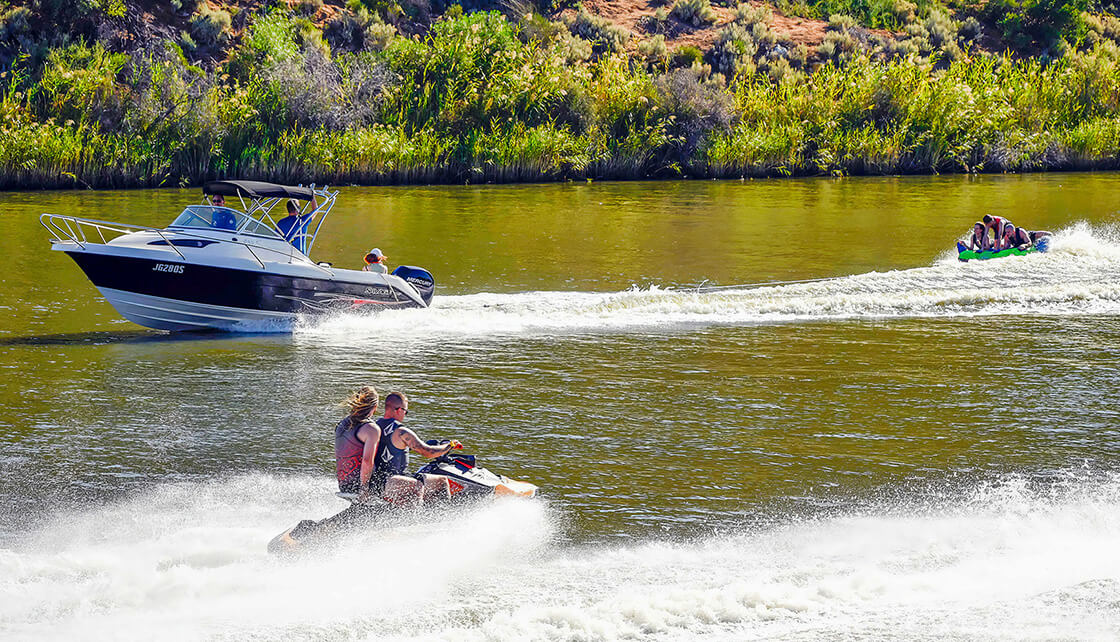
Rivers can become quite busy during peak periods, with jet skis, houseboats, power vessels and an array of non-powered vessels all vying for space at the same time.

For skippers, it’s essential to recognise and understand your role on and in the river, as your actions will have an impact on the shared space and those around you.

Everyone in and on the water needs to observe the regulations and be aware of the local water and weather conditions, the safety equipment requirements for their boat and the type of activities they undertake, and be able to operate their vessel safely.

It’s also important to understand the potential hazards of busy rivers, such as rough water from boat wakes, inappropriate speeds, boats undertaking power turns to pick up riders and skiers and keeping clear of objects in the water.

Complacency and overconfidence can lead to becoming unstuck in risky situations.

Unlike road users, no one on the water is required to display a plate with their driver status, so it’s good to be aware that not everyone has the same level of experience or local knowledge of the river. 

Another point to think about is the activities you’re taking part in and how they may impact both the environment and the community. For example, skippers of powered vessels should consider how the boat’s wash might affect the location and others on the water.

Popular boating activities such as wakeboarding and wakesurfing require a powerful wake to ride on that can be disruptive as it moves away from your boat, so keep a good distance from waterfront homes and swimmers, and maintain legal distance from jetties, houseboats and so on.

Where possible, enjoy these activities in an area with little to no boating traffic or during quieter periods.

Take the time to get to know your jet ski so you can understand how it responds when starting, stopping and steering, and know where its safety features are located. Driving at high speed and launching these agile machines over large waves and boat wakes is an unnecessary risk – especially on busy waterways.

Boating etiquette should always be upheld by jet ski riders too, and just like everyone else on the water, they’re required to adhere to the local regulations, including speed and distance restrictions.

Tow sports are another fun activity that need to be planned well according to the type of activity, whether towing tubes, wakeboarders or skiers. Consider the rider’s ability, the water conditions and the location – a bumpy ride through rough waters might not be much fun for children or inexperienced people, and performing sharp turns can make the ride risky.

Ideally, this type of activity should be done away from any structures on the shoreline such as shacks, jetties and navigation poles, as well as fallen or submerged trees, and in high-traffic areas.

Water skiers like flat water and low winds, which is why you’ll see them out early in the morning and later in the evening when water disturbance is minimal, while wakeboarders head to low-traffic areas where there’s lots of space. 

When planning your day, check if local rules apply, such as designated no-tow areas and ramp rules, and check that you have all the necessary safety equipment onboard and that everything is serviced and in date.

Everyone has a role to play in towing activities, from the driver and observer to the riders and those cheering them on.

While some of these tips might be different outside of SA, on-water speeds, distances to others, reducing boat speed to avoid wash, and consumption of alcohol and drugs is regulated throughout the country.

  • If you’re the skipper, it’s your responsibility to ensure the safety of your crew and the people being towed
  • Before heading out, brief each participant and the observers on their roles and responsibilities including hand signals, measures to avoid propeller strike, and how to recover and reboard a downed skier, boarder or rider
  • Your skipper’s brief should also include your safety plan, including where the equipment is stored and how to use it, and general safe boating behaviour
  • Take extra care when towing and watch out for floating debris, underwater hazards and downed skiers
  • Keep clear of structures, swimmers, other boats and non-powered craft, and be mindful of the effect of your boat wash and wake on others in the water around you 
  • Give way to boats entering a take-off area if you are heading out
  • Ski ropes or skis trailing from a boat must be removed from the water before arriving at a take-off area
  • If someone is towing a skier in front of you, you must keep more than 100m distance from the person being towed
  • Anyone being towed must wear a correctly fitting level 50 or 50S life jacket
  • In SA, 0.05 blood alcohol limits apply to skippers, observers and skiers; blood drug content limits also apply
  • In SA, no more than three people, or one device carrying up to three people, may be towed at one time
  • Remember to keep the boat speed to 4 knots within 50m of swimmers and anyone operating unpowered craft such as kayaks, paddle boards and canoes
  • Keep to 4 knots within 30m of any other vessel that can be adversely affected by your boat’s wash

An added level of safety and vigilance is needed when children are aboard, which is highlighted in Safe Transport Victoria’s Boating with Kids awareness program.

Shane Leversha, Director People and Communications at Safe Transport Victoria, said: “Taking your kids out on the water is a great way to enjoy boating as a family, but it’s important to be safe and have a fun day out on the water. Supervise children, make sure they’re within arm’s reach, and make sure they always wear a life jacket”.

It’s also recommended that children should be seated at all times on a moving vessel, preferably at the rear of the boat rather than on the bow seating.

While the bow is definitely one of the best places to sit, with its uninterrupted views and the feeling of floating above water, passengers should be fully seated and avoid leaning on or over the bow or sides of the boat. If you need to move around while the boat is underway, remember to hold on at all times.

Choppy conditions, unexpected waves and turning sharply can cause a passenger to fall overboard. 

There are some simple ways to reduce the risk of this occurring such as always shutting down the engine while passengers are entering or exiting the boat, never operating your boat near anyone in the water, and ensuring your passengers are seated and holding on at all times.

To read more about the Boating with Kids program head to: safetransport.vic.gov.au/boating-with-kids

Life jacket regulations apply to all water users from jet skis and boats, to kayaks, canoes and paddleboards – including when on rivers and lakes. While all life jackets in Australia must meet the Australian Standard (AS) 4758, the life jacket regulations vary according to the type of vessel, distance to shore, the conditions, and the type of waters you’re on.

The regulations for children are different to adults, and they also differ among the states and can change from time to time, so be sure to check the marine safety authority website in your state for details. And, given that life jacket use is regulated, be aware that you can be fined if you or others on your vessel aren’t compliant.

With a bit of planning, courtesy and attention to safety, everyone will be able to enjoy their day out. The goal is to have a wonderful river experience and to be safe.

* Rachel Paues is the Wakeboard SA Sponsorship and Donations Manager and is passionate about improving watersport safety (and fun) through education and training.

Give us a call on 1300 00 CLUB (2582)
Any discounts offered are applied to our standard rates. Promotional or other discounts may apply from time to time. Minimum premiums may apply. Any discounts/entitlements only apply to the extent any minimum premium is not reached. Where discounts are applied, your premium is subject to rounding. If you are eligible for more than one, we also apply each of them in a predetermined order to the premium (excluding taxes and government charges) as reduced by any prior applied discounts/entitlements.

Any advice here does not take into account your individual objectives, financial situation or needs. Terms, conditions, limits and exclusions apply. Before making a decision about Club Marine boat insurance, consider the Product Disclosure Statement (PDS)/Policy Document and Supplementary PDS (if applicable). Where applicable, the PDS/Policy Document, Supplementary PDS and Target Market Determination (TMD) for Club Marine boat insurance are available on this website. We do not provide any form of advice if you call us to enquire about or purchase a product.

Club Marine Limited (ABN 12 007 588 347), AFSL 236916 issues Club Marine boat insurance and handles and settles claims as agent for the insurer Allianz Australia Insurance Limited (ABN 15 000 122 850) AFSL 234708 (Allianz). Club Marine Limited is a related body corporate of Allianz. Copyright © 2026 Allianz Australia Limited.