How to choose a life raft

Catherine Lawson

On a transatlantic crossing in 1982, American author, naval architect and experienced sailor Steve Callahan escaped into his Avon six-person life raft after his 21ft sloop Napolean Solo was holed in an underwater collision.

Before the yacht sank, Callahan made several trips aboard to salvage navigation charts, flares, a spear gun, a torch, a sleeping bag and three solar stills for making drinking water, among other items, which helped him survive a 76-day westward drift across the Atlantic.

Activating his EPIRB raised no rescue – signals weren’t monitored by satellites in 1982 – but a lot has changed for the better since then and, thankfully, the time one expects to spend in a life raft before being rescued has shortened to just days, if not sooner.
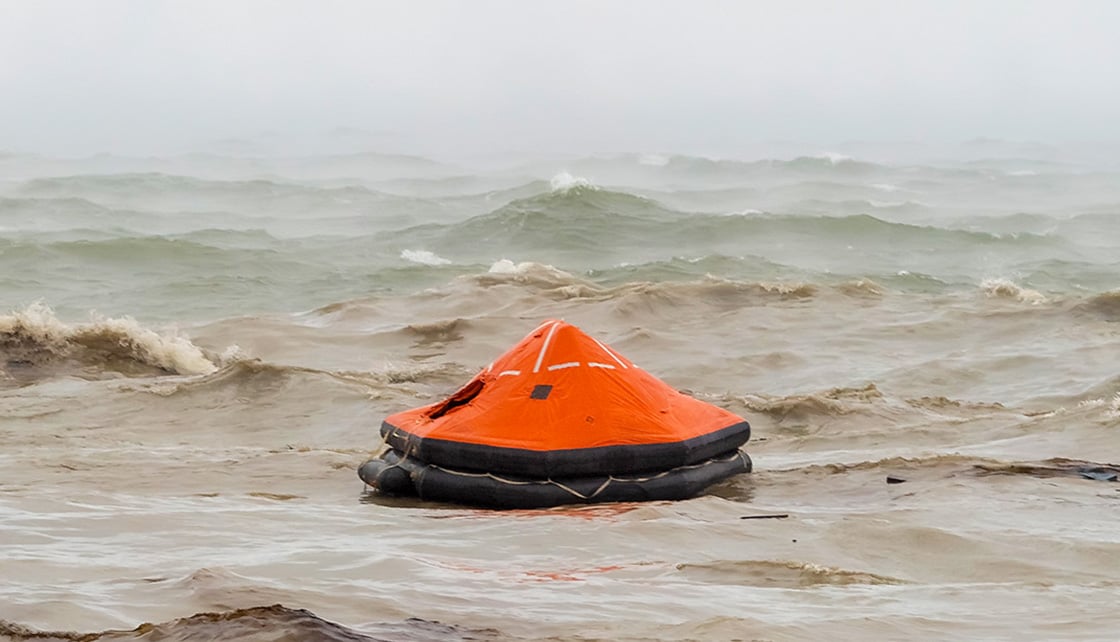
When choosing a life raft, the first consideration is how far off the coast you plan to go, since rafts are designed and rated to survive either coastal conditions or rougher offshore waters. The most universally accepted international standard for life rafts applies to all sail and motorboats up to 24m.

ISO 9650-1 sets the standard for boats used in offshore or transoceanic conditions, while ISO9650-2 life rafts are designed for onshore waters – coastal 

Anticipating that you’ll spend more time in them prior to rescue, Type 1 life rafts are more durable and buoyant, with thermally insulated floors, higher freeboards and more floor space per person. They come with beefed-up emergency packs too.

Type 2 coastal rafts (ISO9650-2) tend to be more affordable and weigh less, which aids handling and deploying, and come with just enough equipment and supplies to help you survive until your rescue, predicted to be less than 24 hours wait time.

SOLAS-standard rafts rate higher than both Type 1 and 2. They’re engineered to survive a minimum of 30 days at sea, are well stocked with emergency supplies, and come with higher price tags.

Apart from being mandatory in yacht racing above Category 4, life rafts are compulsory in South Australia for boats over 15m when operating offshore. In Victoria, boats over 12m that are operating 2nm offshore must have either a life raft or dinghy aboard. Life rafts are not mandatory in Queensland, NSW, Western Australia or the Northern Territory.

Marine life rafts are sized to fit four, six, eight, 10 or 12 people, and it’s important to choose a model that’s the right size for your crew. While Callahan survived his ordeal in a six-person raft, this wasn’t ideal as the right number of people aboard acts as ballast.

For a couple or a family with one to two children, a four-person raft is a good fit and is generally light enough to be handled and deployed by one person. However, a crew of four large adults might baulk at sharing the average 1.5m2 of floor space that a four-person raft provides, and move up to a six-person model instead.

If your crew size changes depending on your adventures, consider buying two smaller rafts. These will be easier to store and launch, and better suited to when fewer people are aboard.

Consider where you’ll purchase your raft and where you can get it serviced, as most models need to be serviced every two or three years for an inflation test and to add new flares, medicine and supplies before the raft is repacked.

When a life raft is tossed into the sea, inflation happens in one of two ways: you either pull the rip cord attaching the raft to your vessel until inflation is triggered, or it happens automatically via a hydrostatic unit that relies on water pressure to trigger inflation.

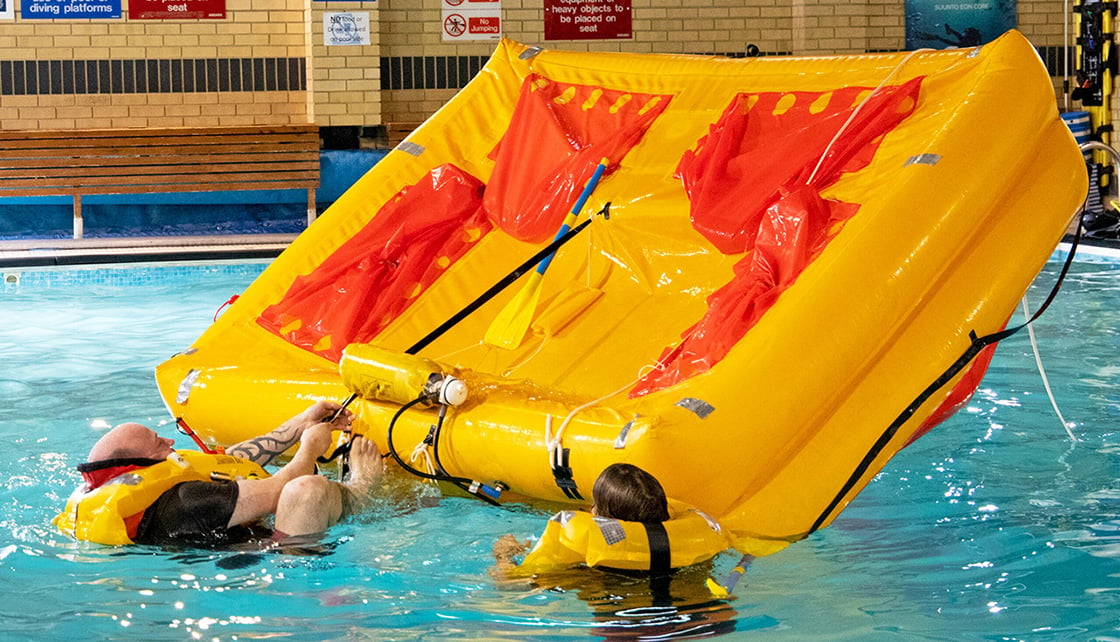
Should a raft capsize upon deployment, some top-of-the-line models have a self-righting design that saves you having to jump into the sea to flip it back over.

In the aftermath of the 1998 Sydney Hobart Yacht Race, the then NSW State Coroner John Abernethy was critical of life rafts he considered too lightweight and too cost-effective, singling out webbing ladders for being ineffective.

Ideally, rafts should have an inflatable or semi-rigid boarding ramp, combined with a weighted ladder loop for feet, and plenty of exterior lifelines to cling to. While the majority do, some of the top-selling rafts still have floaty webbing ladders.

The next things to consider is how easy it is to access. A large canopy opening helps you hit the target when jumping from your vessel. If you’re winched out by helicopter, the large opening may negate the need for you to enter the water.

Some larger-sized rafts come with two canopy openings, which can accelerate crew entry and provide cross ventilation, but this can also increase water ingress in heavy seas.

ISO9650-1 life rafts are built upon two separate buoyancy tubes or chambers that can independently support the full contingent of raft occupants, offering redundancy if one system fails.

Overhead, single or twin independent inflatable arches provide structural integrity. Below, large fast-filling ballast bags help keep the raft stable and prevent it from capsizing. For example, four-person rafts often have four ballast bags, each holding from 55lt to 75lt of seawater.

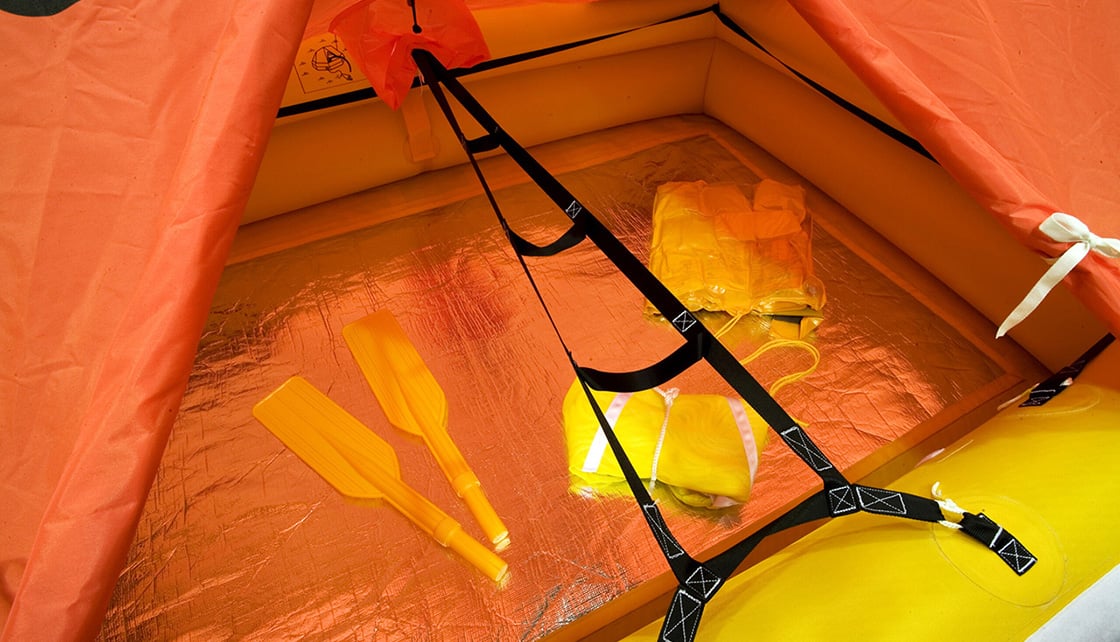
To help ward off hypothermia, insulated foam cell or inflatable floors and a two-layer canopy help retain body warmth, while canopy openings and ventilation ports aid cross flow of air.

When it comes to fitted accessories, an exterior strobe light and SOLAS reflective tape, plus an internal light (preferably LED) are standard, with some rafts offering an inbuilt rainwater collector.

Type 1 coastal-rated life rafts with ‘less than 24 hour’ survival kits include a sea anchor (preferably on a swivel), flares, paddles, a buoyant knife, bailer and sponge, a raft repair kit and manual pump, seasickness tablets and bags, torch, maybe a whistle or signal mirror, and a half litre of water per person.

In addition to these items, Type 1 offshore life rafts and those with ‘over 24 hour’ emergency kits add food, increased water rations (1.5lt per person), a first-aid kit and thermal survival bags. Top-of-the-line models include an EPIRB and some even a watermaker.

Rafts come in a hard fibreglass or carbonfibre canister, or a soft, duffle-style bag called a valise.

Valise packs are lighter and slightly cheaper than hard canisters, and some say less prone to theft since they can be stowed out of sight. Their downside is their susceptibility to weather damage, meaning they must be stored belowdecks or in a dry, dedicated cockpit locker.

Hard canisters can be mounted in a cradle off the stern or side rails, or lashed to the foredeck. There’s no dashing downstairs to drag it up onto deck, and its hard casing means there’s less risk of the raft being punctured during storage.

While round rafts are considered more stable, thanks to occupants having to sit with their backs to the wall, they’re tight spaces that don’t allow anyone to stretch out easily.

Rectangular models provide better leg room, allowing at least some in the raft to lie down, which in turn helps lower the centre of gravity and make the raft more stable. Larger-sized rafts are often hexagonal- or octagonal-shaped.

Ultimately, your choice will come down to what features matter to you most and how far your budget stretches.

A FULL GUIDE TO LIFE RAFTS RAN IN THE FEBRUARY-MARCH (40.1) ISSUE OF CLUB MARINE MAGAZINE

Give us a call on 1300 00 CLUB (2582)

Any discounts offered are applied to our standard rates. Promotional or other discounts may apply from time to time. Minimum premiums may apply. Any discounts/entitlements only apply to the extent any minimum premium is not reached. Where discounts are applied, your premium is subject to rounding. If you are eligible for more than one, we also apply each of them in a predetermined order to the premium (excluding taxes and government charges) as reduced by any prior applied discounts/entitlements.

Any advice here does not take into account your individual objectives, financial situation or needs. Terms, conditions, limits and exclusions apply. Before making a decision about Club Marine boat insurance, consider the Product Disclosure Statement (PDS)/Policy Document and Supplementary PDS (if applicable). Where applicable, the PDS/Policy Document, Supplementary PDS and Target Market Determination (TMD) for Club Marine boat insurance are available on this website. We do not provide any form of advice if you call us to enquire about or purchase a product.

Club Marine Limited (ABN 12 007 588 347), AFSL 236916 issues Club Marine boat insurance and handles and settles claims as agent for the insurer Allianz Australia Insurance Limited (ABN 15 000 122 850) AFSL 234708 (Allianz). Club Marine Limited is a related body corporate of Allianz. Copyright © 2026 Allianz Australia Limited.