Driving your boat in tight spaces

Chris Bell

Even professional skippers can experience some anxiety when faced with a challenging close-quarters manoeuvre, no matter how many bow thrusters their vessel has or how many crew are at the ready.

Sooner or later, every boater will need to get their vessel in and out of a tight spot, be that in a marina, alongside a dock, or bow-first onto a riverbank. A good understanding of some fundamental concepts will help you master the art of close-quarters manoeuvring so you, too, can be confident in your approach.

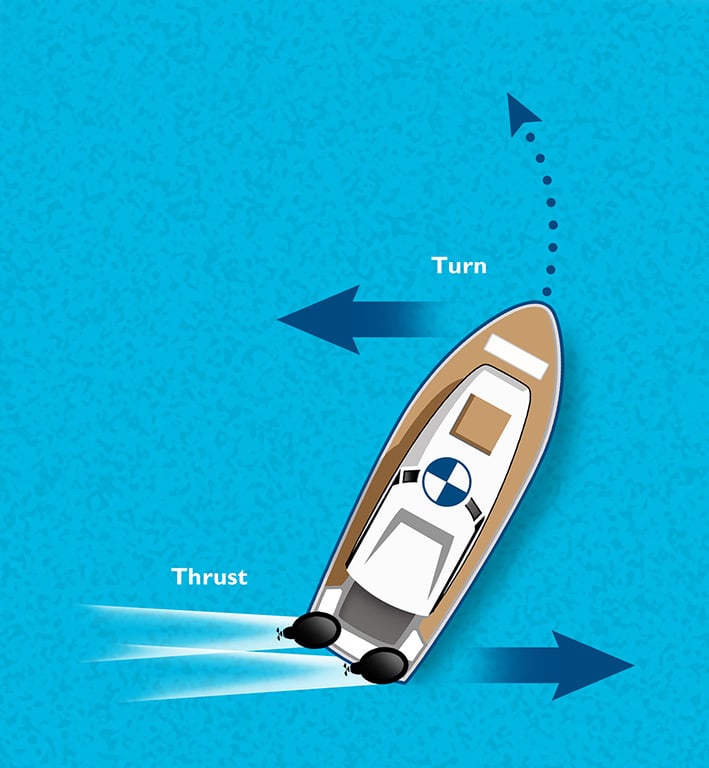
When you push the throttle forward or astern, thrust is developed at the propeller in two ways. The most obvious is called axial thrust – that is the force that drives your boat forward or backward along the axis of rotation of the propeller.

Less recognisable is transverse thrust. This is the sideways force that the propeller exerts on the stern, particularly at low speeds or when stationary. It’s caused by the propeller’s clockwise or anticlockwise rotation in the water.

When viewed from behind, a propeller that turns clockwise in forward gear is called a right-handed prop. One that turns anticlockwise is a left-handed prop, which is less common in single-screw boats.

When you engage astern gear (reverse gear), a right-handed prop will tend to move the stern to port, while a left-handed prop will move the stern to starboard. This concept is very useful when you’re coming alongside a wharf or turning in a short space with a single inboard engine. 

An outboard motor or a sterndrive unit is a directional or ‘active’ rudder. This means that when you engage reverse gear, wherever you point it is the direction your stern will go. When you engage ahead, the opposite is true.

Remember this simple concept if you’re new to boating before randomly pushing the throttle back and forth hoping for the best. 

Inboard shaft drives are more nuanced in how they steer as they use a ‘passive’ rudder that’s located immediately behind the propeller to direct water flow. Fun fact: a boat does not steer like a car. It does, however, have more in common with a forklift.

When you’re at the helm, forget how you drive your car and appreciate that your boat steers from the back, not from the front. As the boat starts to move forward, the pivot point also moves forward to the front half of the hull, so it behaves more like a forklift where the back wheels control the steering.

When a propeller is operating at high revolutions closer to the water’s surface than it should be, air will be drawn down and into the propeller’s rotation. This forms a series of voids around each blade that disrupt the high- and low-pressure zones required to drive the vessel forward or astern with maximum efficiency.

This effect is often called ‘cavitation’, but its proper name is ventilation, and it’s most commonly experienced when engaging astern gear with high revs while still moving forwards. The propeller loses almost all efficiency, which can present a significant danger when approaching a wharf or mooring.

When going astern, boats want to point their stern into the wind, even when using an outboard motor. So keep this in mind before you back out of a pen, or any other close-quarters situation, and be ready to counter this effect.

Light-displacement boats are particularly affected by windshear as the bow easily blows off to the side when reversing, and the stern hunts into the wind.

A boat with two engines is a powerful manoeuvring tool. By engaging astern on one engine and ahead on the other, you can turn your vessel completely around in its own length. And by judicious use of the rudders, you might even be able to walk your vessel sideways without needing a bow thruster.

The propellers of a twin screw should be counter rotating, so transverse thrust is negated when both engines are in the same gear. Usually, the starboard prop is right-handed and the port prop is left-handed.

A single-screw vessel will usually have a right-handed propeller, so turning to port is a smaller turning circle than turning to starboard because when in ahead, the transverse thrust assists the turn rather than fights it.

Sometimes, timidity on the throttle does not point you where you need to go in a confined area, and bold action with throttle and rudder is the only solution with single screws.

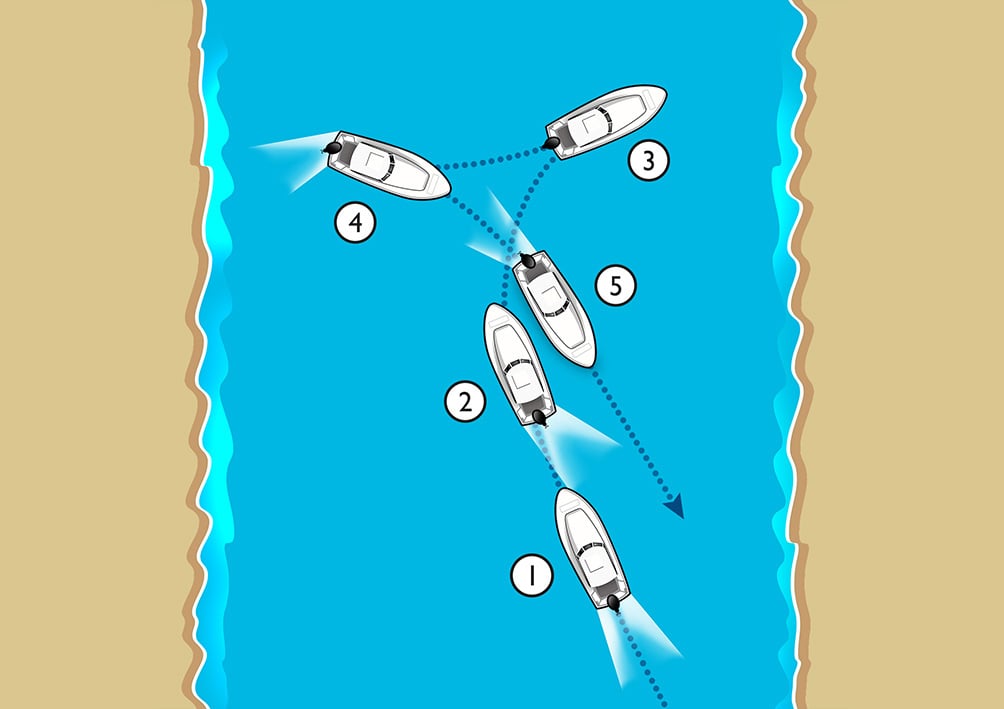
When you’re stationary, trying to manoeuvre in a marina, sometimes there is nothing for it but to ‘give it some herbs’ with a short burst ahead and the rudder ‘hard over’. The idea is not to go forwards, but rather to kick the stern hard to one side or the other, and so align yourself properly for further action.

Inertia is your friend here, because you must go back to neutral gear before you start moving forward. 

This technique utilises transverse thrust and is akin to a three-point turn in a car  … except, of course, it’s not a car, so there is more to it.

  1. If you have a right-handed propeller, put the helm hard to starboard while making very slow headway. Keep the helm in this position throughout the manoeuvre.
  2.  Apply a short burst of ahead power to kick the stern to port and gain some headway.
  3.  As the boat gains headway, apply moderate revs in astern, but not enough to start going astern or to ventilate the propeller. The transverse thrust should kick your stern further around to port significantly.
  4. Centralise the helm and drive off.

Because most single-screw boats have a right-handed propellor, they prefer to berth on the port side. This is because when in astern gear, the back of the boat will kick in towards the wharf very nicely with transverse thrust, especially while you’re going slightly forward and are approaching the wharf at an optimal angle of about 30 degrees.

Just before you reach the wharf, put the helm hard to starboard and engage astern gear with enough revs for you to notice that the transverse thrust is doing its job.

If you need to park starboard-side to a wharf, the transverse thrust will work against you and kick your stern away from the wharf when in astern gear. You can reduce this by maintaining a very slow approach to the wharf, gliding in at a shallower angle of around 15 degrees.

When you’re close to the wharf and almost stationary, give the boat a gentle ‘short burst ahead’ with the helm to port, to bring the stern in.

Give us a call on 1300 00 CLUB (2582)

Any discounts offered are applied to our standard rates. Promotional or other discounts may apply from time to time. Minimum premiums may apply. Any discounts/entitlements only apply to the extent any minimum premium is not reached. Where discounts are applied, your premium is subject to rounding. If you are eligible for more than one, we also apply each of them in a predetermined order to the premium (excluding taxes and government charges) as reduced by any prior applied discounts/entitlements.

Any advice here does not take into account your individual objectives, financial situation or needs. Terms, conditions, limits and exclusions apply. Before making a decision about Club Marine boat insurance, consider the Product Disclosure Statement (PDS)/Policy Document and Supplementary PDS (if applicable). Where applicable, the PDS/Policy Document, Supplementary PDS and Target Market Determination (TMD) for Club Marine boat insurance are available on this website. We do not provide any form of advice if you call us to enquire about or purchase a product.

Club Marine Limited (ABN 12 007 588 347), AFSL 236916 issues Club Marine boat insurance and handles and settles claims as agent for the insurer Allianz Australia Insurance Limited (ABN 15 000 122 850) AFSL 234708 (Allianz). Club Marine Limited is a related body corporate of Allianz. Copyright © 2026 Allianz Australia Limited.