Propellers for outboards

Cameron Marshal

There are myriad considerations when it comes to automotive performance and getting your power onto the asphalt, such as wheel size, tyre compound and profile, gear and final drive ratios, transmission modes and more. On outboard-powered boats, however, everything boils down to two main factors: engine set-up, and choice of propeller. 

Every boat, be it a family runabout or a high-speed powerboat, must be set up properly to perform as intended – including the propeller. Most boatbuilders and dealers have this practice down to a fine art and some even call it a science of sorts. 

Let’s look at how a boat’s power gets turned into motion.

An outboard motor does not, in the true sense, have a gearbox. Instead, it incorporates a transmission housed in what’s called the ‘lower unit’, with a fixed gear ratio that best suits the engine. 

Simply put, if an outboard has a 2:1 gear ratio and reaches 6000rpm at wide-open throttle, the propeller will turn at 3000rpm. The lower unit transfers the power from the engine to the propeller, and therefore to the water. And this is why the propeller is the key to whether your boat will sprint like a racehorse or saunter like a carthorse.

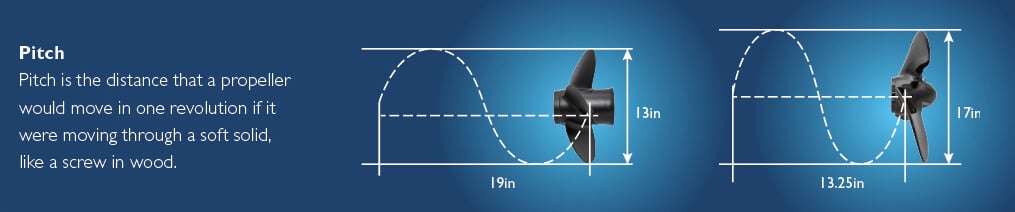
The ‘pitch’ of a propeller is the theoretical distance the propeller will move through the water in one revolution. Even in the metric era, propellers are still categorised in inches – a propeller with a pitch of 19in should, all factors being perfect, drive the boat forward by 19 inches. 

Perfection is not possible, though, and things like propeller slip (every propeller must have a small degree of inherent slip to operate effectively), the cleanliness and design of the hull, and the engine mounting height are all factors to be considered. 

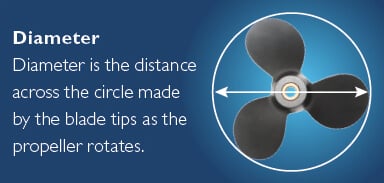
Propellers have different diameters, too, which is the distance across the circle made by the blade tips as the propeller rotates. For example, if you have a propeller with a 13in diameter and 19in pitch but wish to change to a propeller with 17in pitch, the diameter would correspondingly increase to maybe 13.25in. 

The reason for this is to keep the engine rpm relatively uniform. A smaller pitch requires compensatory larger diameter, and vice versa.

The old rule of thumb was that a change of one inch in propeller pitch upward will decrease engine speed by 200 to 300rpm, and one inch downward will increase rpm likewise – this isn’t as relevant with modern four-strokes, which are more tractable and linear, and less ‘peaky’, than the old two-strokes.

But there is no gain to be had by fitting a higher-pitch propeller to a motor already struggling to reach its specified rpm range. It’s actually the opposite, as it’d be like trying to drive a manual-transmission car up a hill in top gear while towing a trailer.

The motor must be fitted with a propeller that allows it to reach the highest boundary of its specified rpm range with the boat light to moderately laden, so that it will still rev properly with a boat full of crew, gear and fuel. Modern four-strokes don’t mind high rpm but they hate being laboured or ‘lugged’. 

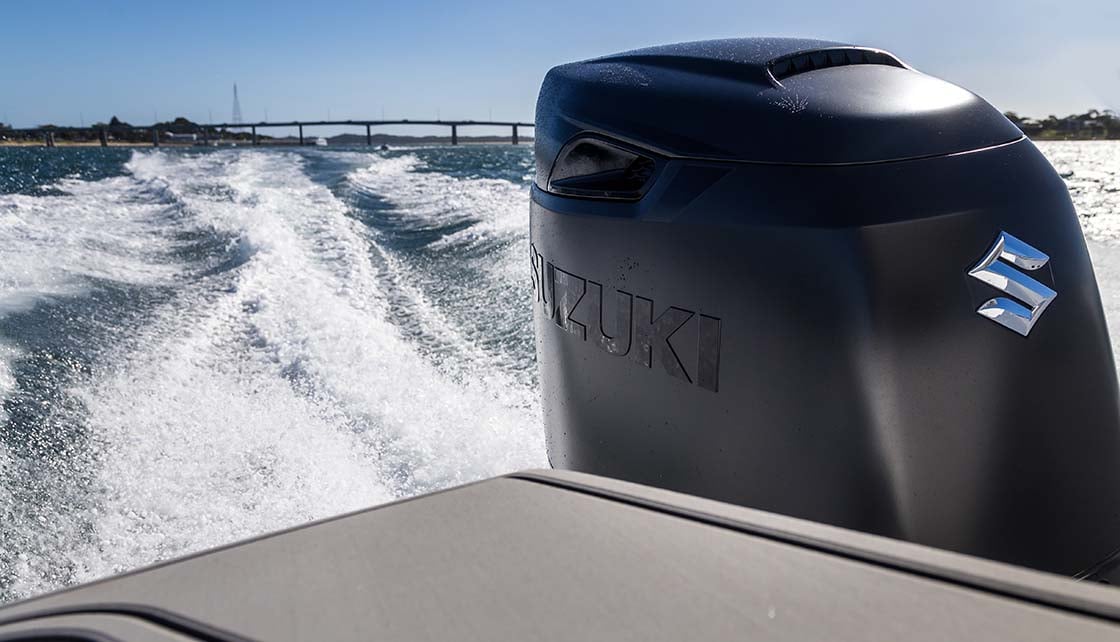
Two outboard models – the 600hp Mercury Verado and the Suzuki DF325/350A –  feature twin propellers that comprise counter-rotating units on a single axis. This feature completely ‘dials out’ the torque bias of a single propeller which, with right-hand rotation, can make the boat veer or lean to port when at speed. 

However, the vast majority of outboards put the power to the water through a single propeller, mainly with three blades. In some cases, more blades may yield better acceleration or stern lift, or keep a stern-heavy boat on plane at lower speeds. But by and large, more blades equate to more drag and lower top speed. 

If a swap is required from a three-blade to a four-blade prop to address a handling or running issue, it will probably be necessary to reduce the pitch due to the extra drag and load from the fourth blade. 

For maximising performance and traction, I am resolutely of the belief that anyone with a high-horsepower outboard of 140hp and more should default towards a stainless steel propeller.

An outboard-powered boat can be afflicted by two conditions, ventilation and cavitation, which can erroneously be mistaken for each other. 

Ventilation occurs when a propeller ‘gulps air’ due to breaking free on a hard turn or when the boat leaves the water at speed. It can also be due to the motor being mounted too high on the transom.

Cavitation is a more serious malady resulting from water around the propeller blades starting to ‘boil’ and form aerated bubbles that collapse against the blade. In severe cases, there will be pitting and dimpling on the blades. 

Cavitation manifests itself in almost the same way as ventilation, but the whine from the motor starts more gradually before building to an angry roar, usually accompanied by a thumping vibration through the entire boat. 

One cause of cavitation is a propeller that’s too large in pitch, whereby the blades cannot effectively ‘hook up’ properly to move the boat. A bent or nicked propeller can also produce cavitation, as can foreign material or growth on the bottom of the boat. 

A common error is to refer to the surface-skimming horizontal flange above the propeller as the ‘cavitation plate’ – the correct name is anti-ventilation plate. 

Of course, many boaters just want a relaxing day on the water without the burden of having to analyse the mechanics of their favourite activity. For many, though, there’s a sense of satisfaction and fulfilment from understanding how the vessel they’re commanding actually works.

Give us a call on 1300 00 CLUB (2582)

Any advice here does not take into account your individual objectives, financial situation or needs. Terms, conditions, limits and exclusions apply. Before making a decision about Club Marine boat insurance, consider the Product Disclosure Statement (PDS)/Policy Document and Supplementary PDS (if applicable). Where applicable, the PDS/Policy Document, Supplementary PDS and Target Market Determination (TMD) for Club Marine boat insurance are available on this website. We do not provide any form of advice if you call us to enquire about or purchase a product.

Club Marine Limited (ABN 12 007 588 347), AFSL 236916 issues Club Marine boat insurance and handles and settles claims as agent for the insurer Allianz Australia Insurance Limited (ABN 15 000 122 850) AFSL 234708 (Allianz). Club Marine Limited is a related body corporate of Allianz. Copyright © 2026 Allianz Australia Limited.