
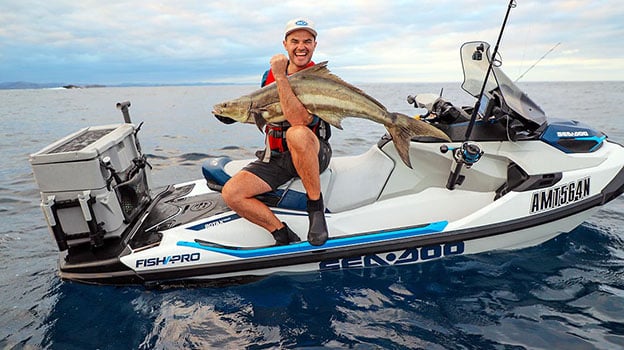
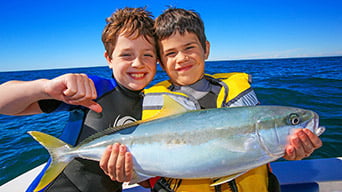
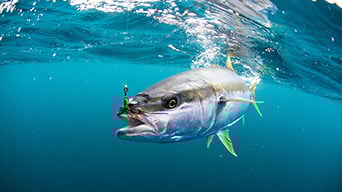
When it comes to the most popular sportfish in Australia, few can rival the yellowtail kingfish. It’s a love hate situation. Few fish pull as hard and as anglers we love the heavy-handed street brawling approach where you literally hang on for dear life and boy do the kingfish take no prisoners. We hate getting destroyed but we can’t help but keep going back for more, it’s like an addiction.
How to catch big Kingfish
Al McGlashan

Where to catch Kingfish in Australia
Kingfish favour temperate and subtropical waters across much of the Indo Pacific Ocean. In Australia they are found across the bottom half of the country from the Abrolhos Islands right around and up the East Coast past Hervey Bay. NSW used to be the stronghold but the numbers seem have been in decline. However new fisheries have emerged down south in Victoria and Tasmania. My old man used to recount tales of kings in the Rip at the entrance to Port Phillip Bay, but I never saw them throughout my adolescence. Now decades later, they have returned, and the fishery is booming. It’s not just in the Rip. Right across Victoria from Portland to Wilsons Prom, huge schools of kings are appearing in ever bigger numbers every year.
Tasmania is also seeing a huge influx. Once a rarity, kings have become a viable target species and now anglers are targeting and catching them consistently right around much of the Apple Isle. The cause behind this huge shift in population densities is still unclear but is most likely to warming oceans.
Kingfish are very much a creature of habit; they regularly return to the same structure time and time again. This can make them easy to predict and ultimately easier catch. In my home waters off Sydney, the kingy hot spots are no secret so it’s more about competing with the crowds. I hate crowds so my secret is to keep moving, checking out each spot until you find your own patch of fish. If you’re unfamiliar with your locally kingy terrain then study the charts and identify distinct structure, especially if it deflects the current this is prime kingy country!
There are other keys to look for on the water. Current and water colour all play a role, but the most important is bait. Find the bait and the kings wont be far away, bait splashing or a patch of birds are subtle signs that will lead you to the fish. However the bait is often deep so you need to use and understand your fish finder to get a clear picture of what’s happening below the surface. As I search each location, I am always watching, not just for kings but more importantly concentrations of bait. What depth it is sitting at is a key factor.
Current is essential and the old story ‘no run, no fun’ couldn’t be truer when it comes to kings. On the east coast, the ideal situation is around a knot of current. If it’s raging, then sometimes it pushes the bait down and the fish with it. Everyone is obsessed with temperature but for me it is less important than current and I have caught kings in water from 16 degrees to more than 26 proving they are certainly resilient.

How to Catch Kingfish
You can catch kingfish using just about every technique from whitebait on a handline to a huge marlin lure. However, the best and most productive techniques are live baiting, jigging, trolling and casting. They are all effective in the right situation with the key being to know when to use one and when to change.
Trolling lures is easy. Throw a couple of deep divers or small skirts out the back and start working right in tight against any structure, be it a ledge or headland. This is a great technique for searching for fish and at the same time you can use the fish finder to pick up any fish that are holding deep. This technique allows you to cover the ground which is also effective if there are patches of birds spread out across the way.
When you find the kings holding over a deep reef then jigging can be the go to method. Again, you use your fish finder to locate the concentrations of fish, then position the boat directly up current of the school so you can drift directly into them as your jig goes down. Retrieves can vary widely depending on the type of jig used but a stop start style retrieve is the best allrounder. The strike doesn’t always occur down near the bottom, remember kings are semi pelagic so they will often hit the jig midwater, so just be ready.
It is important that in deeper water or when the drift is fast, you employ jigs heavy enough to reach the bottom quickly. As far as colour goes, everyone has their favourite and specific colours catch more anglers than fish. There is also a new trend towards micro jigging which is basically a lightweight version with smaller jigs on lighter tackle that is fun until a hoodlum sized fish climbs on!
From the bottom to the top, there are few things as exciting as topwater kings. Using poppers or stick baits are not only incredibly visual styles of fishing but they’re also very productive at times, in fact my biggest Sydney king ever was taken on topwater.
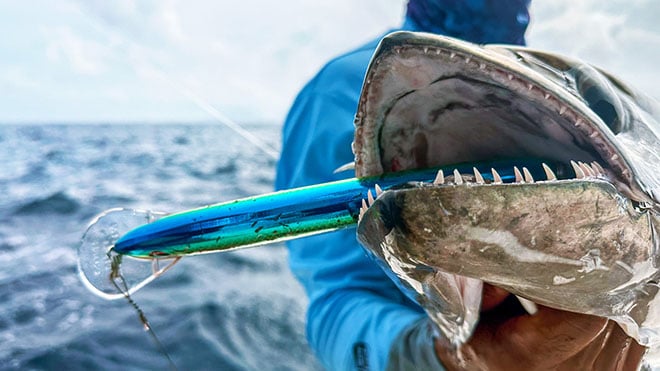
Stick baits have become all the rage but they require a bit of finesse to perfect. The trick is to employ a sweeping retrieve where the bait moves forward with a wide rolling action that swims the lure forward before it pops up on the surface. It’s when it breaks the surface that the kings most often strike. Alternately, sinking swim baits work best when dashing forward then stopping momentarily.
I should add that from my experience the overprized expensive models are also the hardest to use and in most cases you’re smarter to save your money and employ cheaper models. Alternatively, poppers are much easier to use. My favourite, the infamous Roosta popper, is easy to use and works a treat especially on the smaller models of inshore kings. The key is to get it to ‘bloop’ then pause and wait to get smashed.
It’s not just hardbodies that work on top, soft plastics are also very productive in some situations. Twitching a soft plastic, especially stick baits, across the top can drive the kingies crazy especially when they are feeding on the surface on tiny baitfish. Alternatively, add a jig head and send them down to cover more of the water column.


What is the best bait for Kingfish
Artificials are great but in heavily fished areas live baiting is the best option to beat the bigger fish. Squid, slimies, yakkas and garfish are all on top of the kingy menu depending on where you fish. For slimies and yakkas, I always bridle them which helps to keep them alive for a lot longer especially when slow trolling. Squid are the exception and are best rigged on a double circle hook rig, pinning one through the mantle and the second near the head. I should also add that garfish are purely a drift bait and obviously can’t be towed alive!
Trolling live baits is allows you to cover the ground to find the fish. The technique is very simple and works just about anywhere. It’s most effective in shallow water under 30 metres, where you can troll a mix of flat lines where the bait swims naturally on the surface, as well as employing downriggers to get the second bait deeper in the water column. What is interesting is that, from my experience, nearly all of my biggest kings have come off the flat line on the surface, so don’t think the deeper the better!
When fishing over deeper structure beyond the reach of the downriggers, you need to switch to sinkers to weighted bait and get it down fast. How much weight you add is dictated by current and depth but you need to keep the leader to the bait short to minimize tangling on the drop. Instead of trolling this time the best option is to drift over the grounds to keep your bait in the strike zone for as long as possible.
When it comes to hooks there is only one option for bait and that is the in line circle hook. While they do take a bit of getting used to initially as you need to refrain from striking, once you get it right you rarely miss. Better still, circle hooks rarely pull which is such a frustrating way to lose a fish. Above all, hooking them in the corner of the jaw ensures a healthy survival rate for released fish.
Kingfish are subject to ever increasing pressure and with no management plan its up to anglers to lead the way and protect stocks, so only take what you need and always set so free.

Related articles



*Terms and conditions apply
Any discounts offered are applied to our standard rates. Promotional or other discounts may apply from time to time. Minimum premiums may apply. Any discounts/entitlements only apply to the extent any minimum premium is not reached. Where discounts are applied, your premium is subject to rounding. If you are eligible for more than one, we also apply each of them in a predetermined order to the premium (excluding taxes and government charges) as reduced by any prior applied discounts/entitlements.
Any advice here does not take into account your individual objectives, financial situation or needs. Terms, conditions, limits and exclusions apply. Before making a decision about Club Marine boat insurance, consider the Product Disclosure Statement (PDS)/Policy Document and Supplementary PDS (if applicable). Where applicable, the PDS/Policy Document, Supplementary PDS and Target Market Determination (TMD) for Club Marine boat insurance are available on this website. We do not provide any form of advice if you call us to enquire about or purchase a product.
Club Marine Limited (ABN 12 007 588 347), AFSL 236916 issues Club Marine boat insurance and handles and settles claims as agent for the insurer Allianz Australia Insurance Limited (ABN 15 000 122 850) AFSL 234708 (Allianz). Club Marine Limited is a related body corporate of Allianz. Copyright © 2026 Allianz Australia Limited.