Where and how to find tuna

Al McGlashan

In recent years, Australians have been lucky to witness a huge resurgence of bluefin tuna, along with an abundance of yellowfin tuna. Even with good stocks, though, finding tuna in our vast oceans can seem like searching for the proverbial needle in a haystack.

The issue isn’t that the tuna are spread out, rather that they tend to concentrate in very specific pockets of water that are rich in life. Finding these oases in the ocean has long been a hurdle for tuna fishermen, who used to rely solely on visual signs: watching for birds, scanning the sea, searching for tidelines and flotsam, and monitoring the sea-surface temperature gauge.

All of this helps bring you closer to fish if you’re in the right area to start with. But deciding which direction to head when you leave port is the clincher. The good news is we can use technology to improve our chances of striking tuna gold.
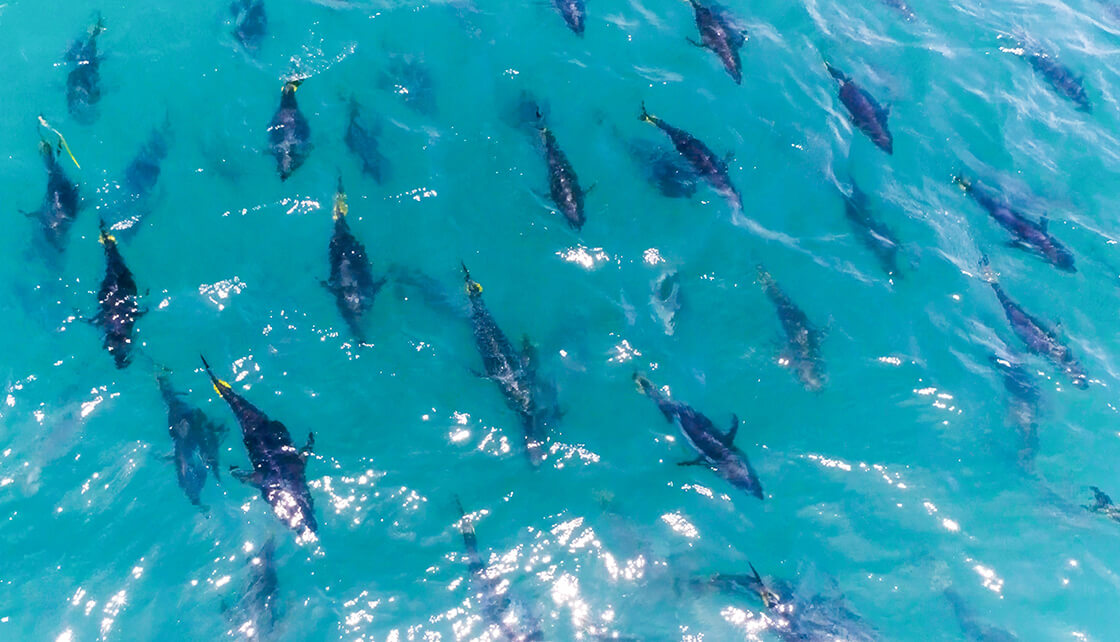
The first trick in tracking tuna is to understand your target species. While similar, tropical yellowfin and cold-water bluefin usually favour very distinct and different environments. 

Yellowfin migrate south along both sides of the country, using the East Australian and Leeuwin currents to reach temperate waters where they feed. 

Bluefin head deeper into colder climes, travelling from the north-eastern corner of the Indian Ocean down the WA coastline and continuing across the Great Australian Bight to Tasmania. They then hook into the East Australian Current (EAC) and move north to feed.

Peak seasons for both fish might vary slightly between locations but winter is prime time. When conditions are right, it’s possible to catch both bluefin and yellowfin in the same waters off the East Coast where their migrations overlap.

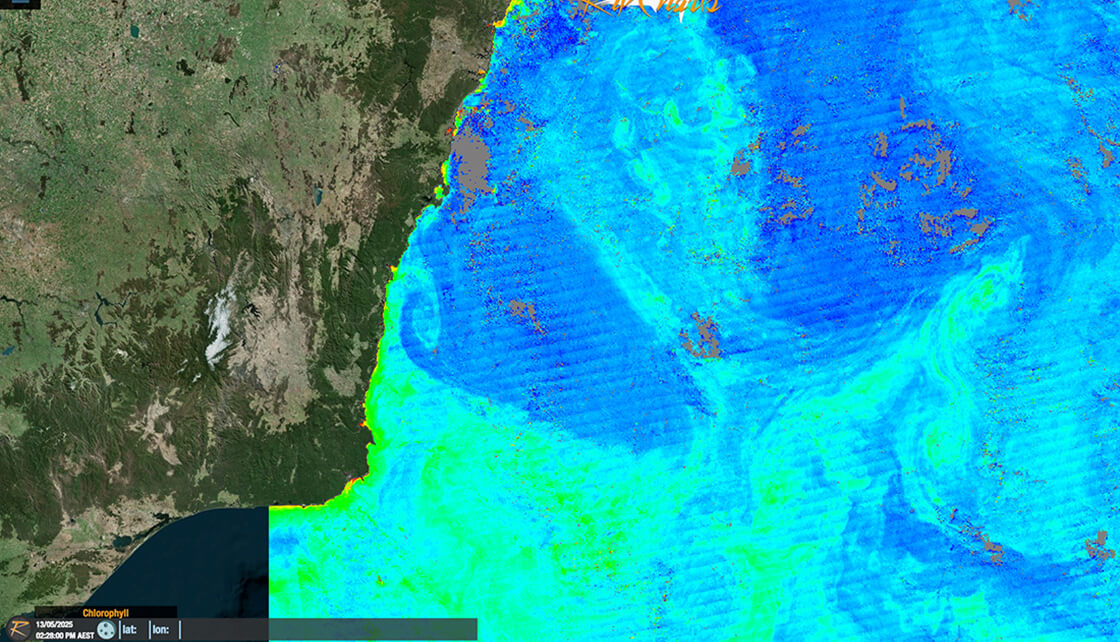
Finding those vibrant pockets of life is the key to becoming a good tuna fisher, and here’s where Sea Surface Temperature (SST) charts come in.

Today, you can jump online and get a near real-time view of the sea’s surface temperature, taking the guesswork out of fishing the right temperatures.

Subscription services such as RipCharts are invaluable, but even free services can be a great guide. They provide amazing data – temperature, current speed, telemetry and so much more – but you need to know how to interpret them.

Tuna love the places where currents collide, especially the bottom edge of the EAC where warm water meets the nutrient-rich Southern Ocean. The chlorophyll that’s found in phytoplankton can be seen on charts – these organisms attract baitfish, which brings in tuna.

Many anglers seem obsessed with finding the hottest water possible, but this may not be key. Tuna, more so than other offshore species, are very sensitive to temperature variations. To make things more difficult, each species favours subtly different water temperatures – bluefin prefer around 18°C, while yellowfin like it slightly warmer at 20°C.

Pelagic fish use currents like a free bus service. Bluefin, for example, ride the current all the way around the bottom of Australia, joining the north-bound current up the East Coast to the delight of waiting anglers.

Watching the SST charts is critical as they reflect current and eddies as they constantly change. Look for abnormalities like a kink or a corner in the main current because this is where fish might concentrate. And, as the current pushes down the coast and kicks up over a canyon or seamount, the resulting upwelling acts as a magnet for pelagics.

A lot of anglers take SST charts as an exact science and fish the exact GPS mark, but water moves, and charts aren’t always in real time, either. Use them only as a guide and, when you’ve found the right area, go old-school – read the water, search the skies for birds and use the fishfinder.

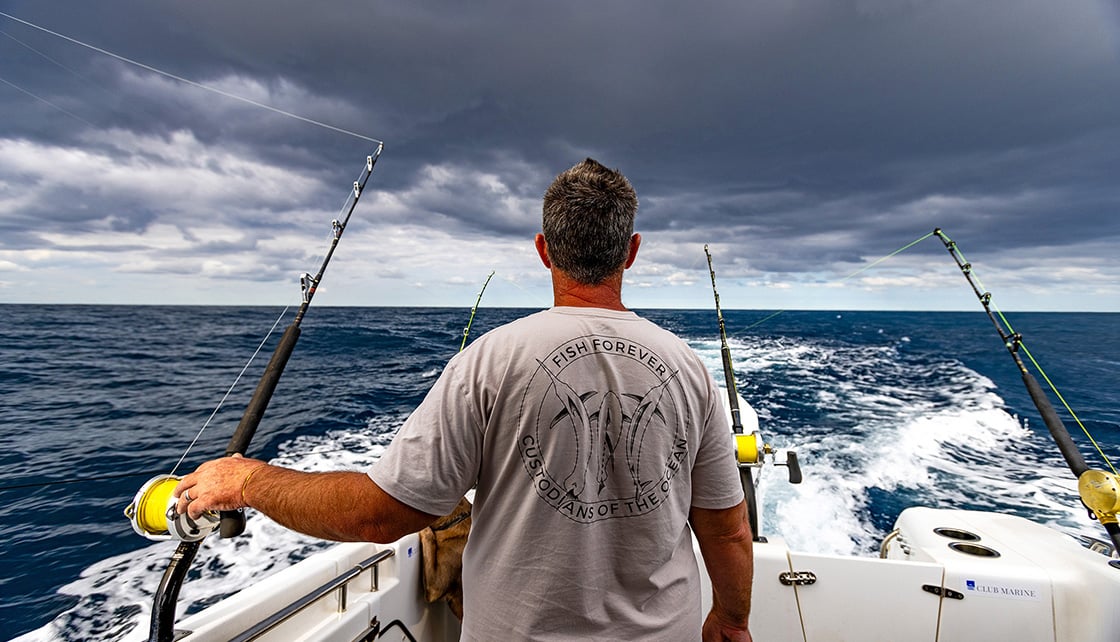
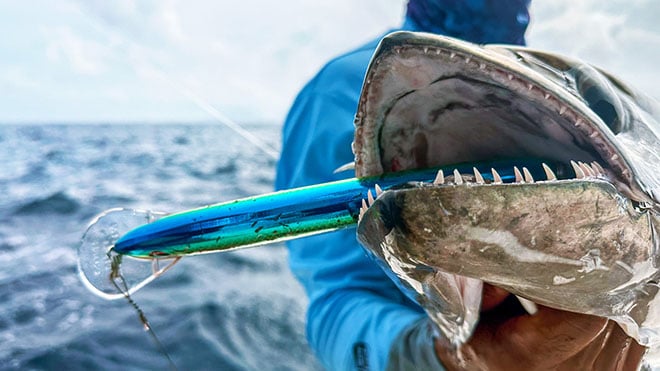
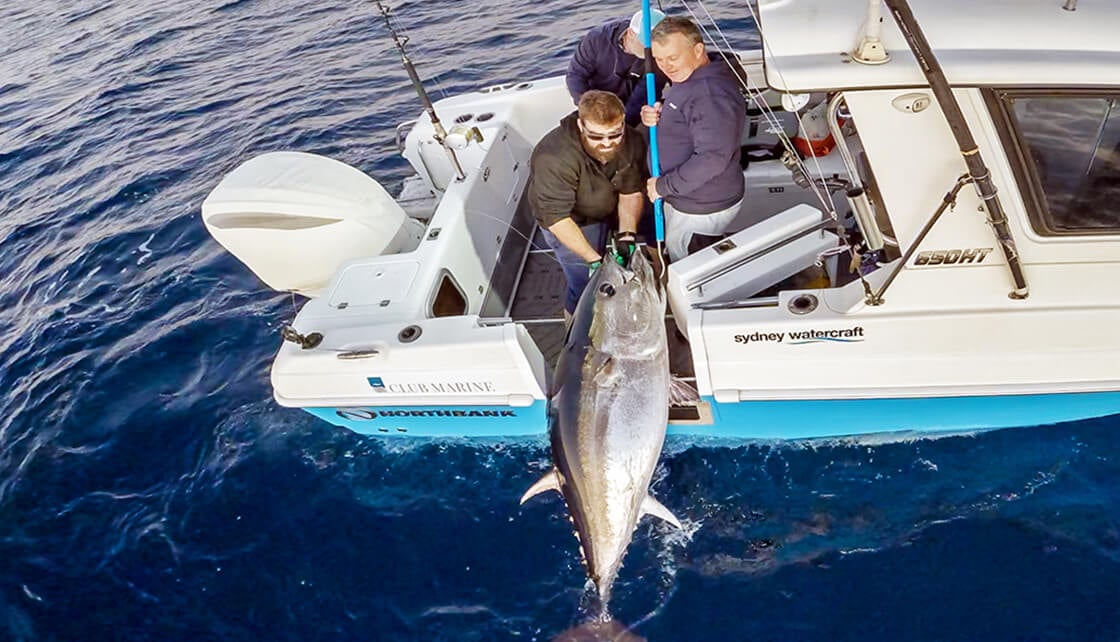
Trolling accounts for the majority of bigger fish caught and is especially deadly on tuna. Nearly all my biggest yellowfin and bluefin have been caught trolling on Laser Pro hard-bodied lures. While I love my Laser Pros, you still need to run a full spread because tuna, especially big ones, can be super fussy at times.

Small is best for lures because tuna feed predominantly on small prey. Choose skirted lures in the 15 to 30cm range, and subtle bullets and jetheads that run with minimal action. I also consider deep divers to be a must.

There are only a few lures that work well for big tuna and can handle being towed while rigged on heavy leader. Be warned: most hard-bodied lures come rigged with trebles, so be sure to switch them out for singles with heavy-duty split rings.

Another consideration is to ensure the lure itself can handle extreme pressure, especially on 24 or 37kg tackle. Tuna are naturally leader-shy and definitely bite less the heavier the leader you use. 

Personally, I vary my trolling speeds between five and eight knots to suit the sea conditions. The two deciding factors are the wake and the harmonics of the engine. 

Don’t be afraid to experiment. This also applies to the distance you run your lures from the boat, so feel free to continually adjust lures to find the best running positions.

When you locate any surface activity, don’t troll through the centre of the feeding fish. Instead, drop the lines right back and then get around in front of the school. Once in position, turn the boat at a right angle so that you pull the spread right across the nose of the fish. 

If you do hook up when trolling, don’t stop after the first rod goes off – just keep moving forward. The actions of the hooked tuna will often attract the rest of the tuna, resulting in a multiple hook-up. 

  1. Know when and where tuna are migrating
  2. Learn to read SST charts
  3. Use small, hard-bodied, skirted lures (15-30cm).
  4. Switch out lure hooks to singles
  5. Vary trolling speed between 5 and 8 knots
  6. Adjust the distance you run out your lures
  7. If you hook up, keep moving for a multiple strike.
Give us a call on 1300 00 CLUB (2582)
Any discounts offered are applied to our standard rates. Promotional or other discounts may apply from time to time. Minimum premiums may apply. Any discounts/entitlements only apply to the extent any minimum premium is not reached. Where discounts are applied, your premium is subject to rounding. If you are eligible for more than one, we also apply each of them in a predetermined order to the premium (excluding taxes and government charges) as reduced by any prior applied discounts/entitlements.

Any advice here does not take into account your individual objectives, financial situation or needs. Terms, conditions, limits and exclusions apply. Before making a decision about Club Marine boat insurance, consider the Product Disclosure Statement (PDS)/Policy Document and Supplementary PDS (if applicable). Where applicable, the PDS/Policy Document, Supplementary PDS and Target Market Determination (TMD) for Club Marine boat insurance are available on this website. We do not provide any form of advice if you call us to enquire about or purchase a product.

Club Marine Limited (ABN 12 007 588 347), AFSL 236916 issues Club Marine boat insurance and handles and settles claims as agent for the insurer Allianz Australia Insurance Limited (ABN 15 000 122 850) AFSL 234708 (Allianz). Club Marine Limited is a related body corporate of Allianz. Copyright © 2026 Allianz Australia Limited.