
Looking back, I am amazed at how far fishing has come in the past few decades as anglers strive to improve how we fish and minimise our impact on the sea. We no longer just keep whatever we catch but try to target a low-impact species that is good eating and plentiful.
Caring for the fish you catch
Al McGlashan

Whole-fish mindset
On average, my family eats fish at least four nights a week. We work really hard to utilise the whole fish and waste nothing, which means that if we chase whiting, we use the frames to catch beach worms to use as bait for our next whiting session. It’s ultimate recycling for anglers.
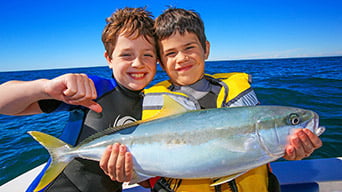
With kingfish, we used to just knock off two basic fillets and grill them, but today we barbecue the wings and the whole backbone to spice up a salad, we dry-age it, grill steaks and serve it in poke bowls.
With a large fish, such as tuna, we’ll take out the cheeks as well, and use the head to make fish stock or recycle the frame as bait for our lobster or crab traps. Even the offcuts are used for burley.
Leading the tag
One of the best examples of anglers’ dedication to conservation is the NSW Gamefish Tagging Program. Since 1973, this citizen science program has become the largest of its kind in the world, and over 500,000 fish have been tagged.
There have been some unbelievable recaptures including several blue marlin that swam from Papua New Guinea to the Philippines, and black marlin that swam to Fiji and beyond.
How to release fish
Fish mortality is a contentious issue but most fish released can survive if they are cared for correctly. It is not simply a matter of tossing them back and hoping for the best, and there are a number of steps you can take to maximise their survival.
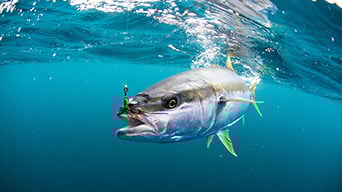
Robust species, such as yellowtail kingfish and black marlin, can handle the rigours of catch-and-release, while others such as jewfish and golden snapper suffer from barotrauma and are best released only in shallow water.

Using the right hook
Starting at the pointy end, you need to use the right hook and there has been a huge swing towards non-offset circles for all natural bait. Deep-hooked fish have a far greater risk of mortality so always try to pin them in the mouth.
Game fishermen were the first to start using circle hooks to improve hook-up rates and reduce mortality rates for billfish and tuna. Adopted from the longline fishery, this hook is now widely used for all species from whiting to flathead, and kings to blue-eye.
Landing your fish
Once hooked up, the next step is to get your fish in fast. This will reduce the chances of tiring the fish out completely and letting those lactic acids build up too much.
The old days of light line and long fights have been replaced by heavy tackle to catch fish quick and get onto the next one. While not as sporting, it aids a successful release and a better-tasting catch, whichever way you choose to go.

Handling fish with care
How you handle the fish once you’ve landed it is really important too – not just for release but if you plan to keep it for dinner, too. First and foremost, minimise contact and keep the fish in the water as much as possible. Some species, such as billfish, should not be lifted out of the water, and dehooking and photos should all be done boatside.
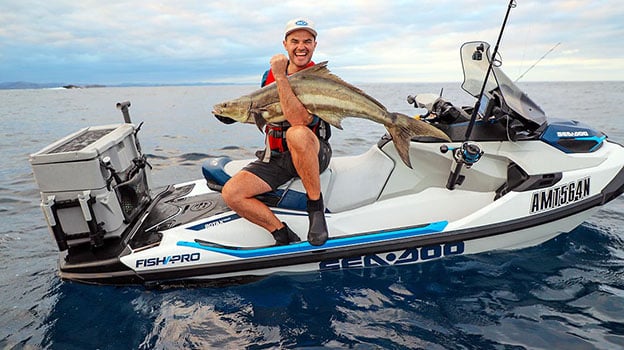
Other species – kingfish and trout, for example – can be lifted up briefly, but always use wet hands, support the fish, and avoid gripping sensitive areas such as the gills.
Obviously, you shouldn’t allow any fish to flip around on the deck. Not only can it damage itself, but it can endanger the crew as well with hooks and gear flicking about.
How to hold a fish
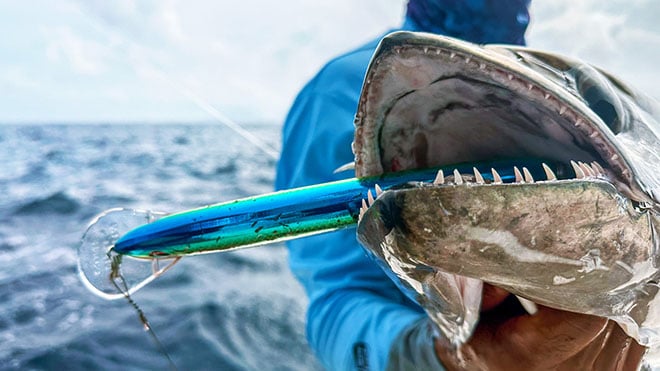
One of the best ways to hold a fish is to put your thumb in their mouth and then lock it down against their bottom jaw with your index finger underneath. The other hand can then support the fish midway down its body. You obviously wouldn’t employ this technique on toothy critters such as mackerel!
Ultimately, the best way to look after a fish is to keep them in the drink so that water continues to run over their gills.
Reviving a fish
Fish all fight differently and, as a result, come to the boat with different levels of exhaustion. It’s easy to assess them and this can help you determine how long they should be revived for.
Marlin are perfect for this job thanks to their bill, which makes a perfect handle and allows you to tow them. Just remember to keep their head submerged so the water is flowing over the gills. When the fish is ready to go they will let you know by paddling their tail or biting down on your fingers.
Some anglers think you need to spear fish into the water to help get the water flowing, but my personal experience is that this action tends to stress the fish. It’s much better to gently lower them into the water while supporting them and let them swim off of their own accord.

RELATED ARTICLES




*Terms and conditions apply
Any discounts offered are applied to our standard rates. Promotional or other discounts may apply from time to time. Minimum premiums may apply. Any discounts/entitlements only apply to the extent any minimum premium is not reached. Where discounts are applied, your premium is subject to rounding. If you are eligible for more than one, we also apply each of them in a predetermined order to the premium (excluding taxes and government charges) as reduced by any prior applied discounts/entitlements.
Any advice here does not take into account your individual objectives, financial situation or needs. Terms, conditions, limits and exclusions apply. Before making a decision about Club Marine boat insurance, consider the Product Disclosure Statement (PDS)/Policy Document and Supplementary PDS (if applicable). Where applicable, the PDS/Policy Document, Supplementary PDS and Target Market Determination (TMD) for Club Marine boat insurance are available on this website. We do not provide any form of advice if you call us to enquire about or purchase a product.
Club Marine Limited (ABN 12 007 588 347), AFSL 236916 issues Club Marine boat insurance and handles and settles claims as agent for the insurer Allianz Australia Insurance Limited (ABN 15 000 122 850) AFSL 234708 (Allianz). Club Marine Limited is a related body corporate of Allianz. Copyright © 2026 Allianz Australia Limited.