Improving your trolling tactics

Al McGlashan

Trolling is one of the easiest and most effective ways to fish. It works on just about any species – from trout to barra, flathead to tuna – in both freshwater and saltwater environments. But the first step is to identify your target species, so you know where to troll to be right in the zone.

The number one rule for all fishing is: you need to fish where the fish are. It doesn’t matter how good your lures are if you’re not getting them in front of the fish.

While a lot of anglers see trolling as lazy, it’s actually highly technical and allows you to cover substantially more ground, however you need to concentrate on specific areas and be clear about which species you’re targeting. And with modern electronic charts, finding those fish-holding spots is easier than ever.

If it’s flathead in estuaries, you’re going to use deep divers like the Halco TB55. However, if you’re chasing mackerel up north, then a shallow-running lure is perfect. It’s important to know where your target species sit in the water column and to understand the terrain. 

While most of us know we need to focus on structure, it’s not always clear what that means. Take the areas where reef edges run for miles – there’s literally too much to choose from there, so you need to narrow down your options, and the key to this is the current.

The current plays a vital role in determining where the fish will be holding up. Look for abnormalities, like an isolated bombora sticking out and disrupting the current by creating an eddy, or a tree on a steep bank in the river. These make for a great place where bait stack up and an ideal hunting ground for predators.

Fish don’t necessarily hide behind structure out of the current; often, it’s the opposite. With the current pushing into the structure, predators like kingfish, tailor and mackerel will often ride the pressure waves up-current. Alternatively, a big dusky flathead in an estuary will tuck in behind the structure out of the current, lying in wait to ambush prey.

To make things easier, I’ll outline a simple rig that consists of just three lures and covers as much of the water column as possible. It works across a wide range of species, from kings to snapper, and is just as effective in freshwater impoundments chasing trout or even some native species.

While you can use this rig to troll headlands, reef edges or drop-offs anywhere around the country, you will need to customise the lures to suit the specific targets  – say, to an Aussie salmon that prefers a smaller shallow-running profile lure or an Aussie bass that’ll go for a deep diver with a slower action.

As a general spread for saltwater, the first lure runs in tight and is a mega-deep diver. The Scorpion Crazy Deep is perfect and dives down quickly, so it can be towed on a relatively short leash – this is important if you’re chasing stubborn species like coral trout that need to be hauled out quickly.

I like to set this lure nice and close, just 20m back. If I’m fishing right in tight against structure, I position it on the outside away from the structure to minimise the chances of snagging.

Being the deepest lure in the spread, it’s important to monitor it for bites and for snags. If you’re fishing an estuary for barra or flathead, you’d swap the lure out for one that matches the depth.

Behind the deep diver, 25 to 30m back, is where I run a medium to shallow diver like the Halco Laser Pro. Fish this lure in the opposite corner to the mega-deep diver, which will minimise the chance of tangles while allowing you to do some tight turns around the structure. It will catch anything from mackerel to tuna.

The final position is a top-water lure. Poppers such as the Halco Roosta are my favourite because they create commotion and sit out the back on their own. If you’re fishing freshwater, this position doesn’t really apply  – a shallow-running lure can work for trout, though.

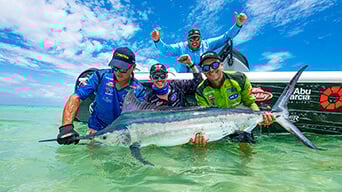
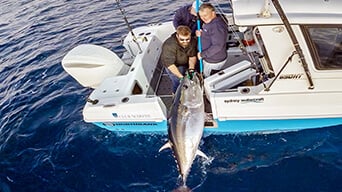
When it comes to fishing offshore for big tuna and marlin, trolling is the most effective option. You can drag plastic lures or fish with natural bait and even livies, but artificials are the most popular lure option worldwide.

I like to keep it keep it uncomplicated and run a spread of just four lures. Up close on the port outrigger, known as the short rigger, I like a big noisy skirt that splashes a lot – it’s dynamite for blue marlin. If I’m in bluefin tuna waters, a Halco Max up short is a worthy swap out.

On the opposite side on the long rigger, I run a 9 to 12in skirt, which is a favourite position for striped marlin and yellowfin tuna.

I also run two lures off the transom, usually with both back behind the riggers instead of shorter. If there are more marlin than tuna, the short corner position is held by a skirt that’s normally a smaller 8 to 9in model in darker colours. If tuna or wahoo are in the area, then instead of a skirt I’ll use the new Halco Laser Pro 210 that can dive to 9m.

Alternatively, way out the back on its own in the shotgun position I like to run a Laser Pro 190 shallow runner. This lure has accounted for my biggest yellowfin and bluefin.

If you see tuna blow up but aren’t getting bites, don’t be afraid to run this one well back. If you’re fishing in an area where there’s a chance of billfish, it can be a wise decision to opt for a skirted lure like a Jet Head instead.

There’s a multitude of lures on the market, but it’s amazing how a few types swim right out of the box, irrespective of price. 

I’ve always stuck to the proven producers such as Halco lures, especially the Laser Pro. They aren’t expensive and always run true at speed. In fact, the Laser Pro 45 is also my favourite trout lure, so they do catch more than tuna.

Everyone has their favourite colours and there are so many to choose from that we can’t cover them all here, but I am going to say that you can always try new things alongside the proven models.

Whichever lure you use for trolling, to ensure it’s running at its optimum always attach it with a loop knot or crimp it. If the lure is still not tracking straight, then bend the towing eye in the opposite way. 

I’ve changed all my heavy-duty lures to singles and the hook rate has definitely improved. The problem is that not all lures run as well on singles, so you may need to do some experimenting.

If you do stick to the trebles, push the barbs down. Not only will this give you a better hook-up rate, it’s also a lot less dangerous when you land the fish.

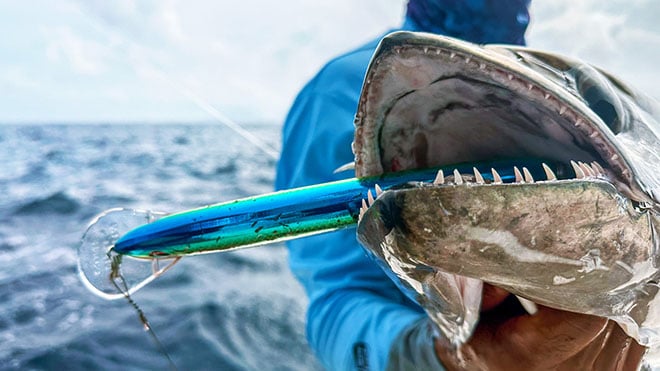
You’ll definitely get more bites on monofilament or fluoro leaders, but for toothy critters like mackerel, especially up in the tropics, you’ll need to run wire. Don’t use multi-strand, instead run a short length of single-strand wire. Attached with a haywire twist, it won’t affect the lure’s action, but it does need to be attached to the main line with a swivel.

  1. Fish where the fish are
  2. Be clear about which species you’re targeting
  3. Understand the structure and current
  4. Use a trolling technique that suits the terrain
  5. Choose proven lures if you’re uncertain
Give us a call on 1300 00 CLUB (2582)
Any discounts offered are applied to our standard rates. Promotional or other discounts may apply from time to time. Minimum premiums may apply. Any discounts/entitlements only apply to the extent any minimum premium is not reached. Where discounts are applied, your premium is subject to rounding. If you are eligible for more than one, we also apply each of them in a predetermined order to the premium (excluding taxes and government charges) as reduced by any prior applied discounts/entitlements.

Any advice here does not take into account your individual objectives, financial situation or needs. Terms, conditions, limits and exclusions apply. Before making a decision about Club Marine boat insurance, consider the Product Disclosure Statement (PDS)/Policy Document and Supplementary PDS (if applicable). Where applicable, the PDS/Policy Document, Supplementary PDS and Target Market Determination (TMD) for Club Marine boat insurance are available on this website. We do not provide any form of advice if you call us to enquire about or purchase a product.

Club Marine Limited (ABN 12 007 588 347), AFSL 236916 issues Club Marine boat insurance and handles and settles claims as agent for the insurer Allianz Australia Insurance Limited (ABN 15 000 122 850) AFSL 234708 (Allianz). Club Marine Limited is a related body corporate of Allianz. Copyright © 2026 Allianz Australia Limited.