How to catch marlin on the flats

Al McGlashan

Barely 50 metres off the beach, trolling a spread of skirted marlin lures seemed absurd for someone who has chased billfish all around the world for their whole life. However, there was no denying the distinct black-shaped tailing inside us on the sand flats.

It wasn’t just one but three separate fish silhouetting vividly against the white sandy backdrop, their sickle-like tails slicing through the surface. In all my years of marlin fishing I never imagined I would witness such a spectacle. 

Moments later we were on a triple. One fell off, the second headed out wide, while my fish went in the opposite direction charging straight for the beach. It just kept jumping skyward until it was just in a few feet of water and then cruised along the surf break. Had there been any swimmers they would have had to exit the water!

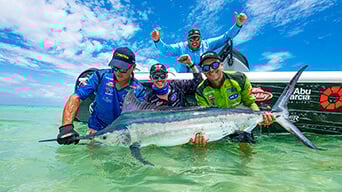
We quickly got the fish boatside after jumping right across the flats and as the guys unhooked it I jumped in and waded over to film the release. Never in my wildest dreams did I think I would film a marlin in such shallow water. Twenty minutes later we were on again and it kept going all morning.

There is only one place I know of where you can genuinely chase marlin on the flats and that is Queensland’s K’gari (Fraser Island). While no one knows exactly why they congregate on the flats inside K’gari, I suspect that the Breaksea Spit, which juts out to the north of the island, acts as a natural obstacle.

The marlin range in size from 10kg through to around 30kg. Being juveniles means they can be caught on relatively light spin tackle – something like a Shimano Spheros 6000 size reel. Loaded with 50lb braid, this is the most inexpensive marlin outfit you’ll ever use.

The only problem with light tackle is getting the hooks to stick when trolling lures. Even at this size, marlin have tough boney mouths that are incredibly hard to penetrate. Super fine gauge hooks are the best option and with the help of a stiff graphite rod you can really load up and get the hooks to find their mark.

One trick I employ is to cup my hand around the spool or thumb an overhead, as this will increase pressure just enough to get the hooks in. It can only be really brief, otherwise you risk snapping the line.

The easiest technique is to troll small skirted lures across the flats. At the same time, you need to be up on the side searching for tailing fish or dark shapes on the flats. This is an incredibly visual style of fishing and with a sandy back drop the fish are easy to spot.

It’s difficult for hardcore marlin fishers to focus in the shallows and not out in the blue water. I constantly went wider searching the deeper water but never caught a single fish. Every marlin we caught (and were talking dozens) were all in less than 10m of water.

The lure spread is nothing fancy. In fact, it’s a pretty stock-standard trolling pattern of four lures, except they’re all only 6 to 8in. If the fish are thick as we found them it’s actually easier to reduce down to three or even two rods.

Fishing the lures further back and out of the propwash also saw an increase in bites. The fish were anything but leader shy and there was little need for super light leaders. There was also no difference between fluorocarbon and normal monofilament leaders, but I suspect this would change when fishing pressure is increased. Trolling the edge will result in a steady stream of bites. 

The fish are so aggressive they will attack a hard-bodied lure continuously, and even when they get stung with a hook they will often keep going. This also goes for fly fishing, and local fishing guide Andrew Chorley has notched cricket score numbers of micro blacks on fly.

The one thing I’d recommend is to run single hooks as they will give you a much better hook-up rate and it’s way better for the fish to compared to those horrible treble hooks. If there was ever a place to catch multiple marlin on surface lures then K’gari is it.

As amazing as this fishery is, the downside is its remoteness. The top end of the island is some 40 miles from Hervey Bay and there are no amenities – just sand, surf and dingoes.

Basically, you can either take up a big cruiser and utilise it as a liveaboard or camp on the island. We camped up at Carree campsite at the very tip of the island near the lighthouse, but this is 12 miles from the fishing grounds. The other alternative is Wathumba Creek, 15 miles inside the bay. It is calmer but the sand flies can be deadly at times. However, you can fish right out the front and all the way to Rooneys Point.

Wherever you decide to camp you need to be self-sufficient. We rolled out the swags and basically lived on fresh fish each night. Mind you, sleeping under a million stars, having caught dozens of black marlin, is about as good as it gets I reckon. It is all part of the adventure that helps to make this fishery one of the most unique marlin fisheries on earth.

You need to remember these marlin are young and tire very quickly so they need extra care. If they’re tired you must swim them for a while and get the water running over their gills. There is also the ever-increasing issue of shark predation. So, you need to get the marlin fast and be very careful.

This is a one-of-a-kind location and the fish are just too valuable so it’s imperative that anglers act as true custodians to ensure we have fish forever. 

Give us a call on 1300 00 CLUB (2582)
Any discounts offered are applied to our standard rates. Promotional or other discounts may apply from time to time. Minimum premiums may apply. Any discounts/entitlements only apply to the extent any minimum premium is not reached. Where discounts are applied, your premium is subject to rounding. If you are eligible for more than one, we also apply each of them in a predetermined order to the premium (excluding taxes and government charges) as reduced by any prior applied discounts/entitlements.

Any advice here does not take into account your individual objectives, financial situation or needs. Terms, conditions, limits and exclusions apply. Before making a decision about Club Marine boat insurance, consider the Product Disclosure Statement (PDS)/Policy Document and Supplementary PDS (if applicable). Where applicable, the PDS/Policy Document, Supplementary PDS and Target Market Determination (TMD) for Club Marine boat insurance are available on this website. We do not provide any form of advice if you call us to enquire about or purchase a product.

Club Marine Limited (ABN 12 007 588 347), AFSL 236916 issues Club Marine boat insurance and handles and settles claims as agent for the insurer Allianz Australia Insurance Limited (ABN 15 000 122 850) AFSL 234708 (Allianz). Club Marine Limited is a related body corporate of Allianz. Copyright © 2026 Allianz Australia Limited.