
- Consider ease of use and setup: When choosing water sports toys like kayaks, foil boards, kite surfing gear, sea scooters, and SUPs, prioritize items that are lightweight, easy to launch, set up, and store onboard to maximize usage and enjoyment.
- Kayaks and Foil Boards: Lightweight kayaks are ideal for easy handling and storage, with options like inflatable models for quick setup. Foil boards offer versatility across different water conditions, with beginner-friendly packages available that include boards, wings, and foils.
- Sea Scooters and SUPs: Sea scooters vary in design for different user needs, from shallow-water family use to deep-diving adventures. SUPs offer stability for beginners and can be inflatable for compact storage, with options tailored to skill level and intended use, such as yoga or wave riding.
Buyer's guide to water sports toys
By Catherine Lawson
Quick overview
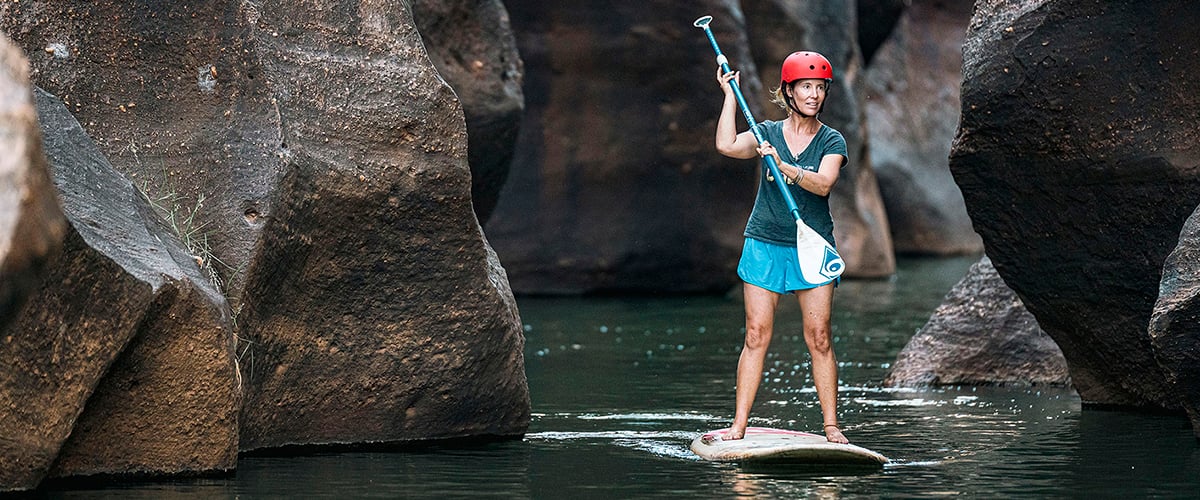
From SUPs to sea scooters, kayaks to wing foils, water toys turn every anchorage into an adventure playground, on and under the waves. But before you consider this simple truth: the amount of time you use any water toy on a boat depends entirely on how easy they are to launch.
If a kayak turns out to be too heavy to carry, or a sea scooter battery takes all afternoon to recharge, or a foil wing takes too long to pump up, you’ll start to use it less and less. So make sure the gear you choose is reliable, quick to set up, and easy to handle and store onboard.
Kayaks
Lightweight kayaks
Look for a lightweight, easily handled kayak that tracks well, is quick to set up, has a comfortable seat and provides plenty of storage. It should be easy to get on and off your boat – and perhaps your car’s rooftop, too.
An inflatable kayak that you can set up in five minutes, Razor’s X1 High-Pressure kayak weighs 12.9kg. Measuring 3.9m, its proportions are easily managed by a single kayaker, and a narrow, sleek design makes it fast and manoeuvrable.
Made of high-pressure Tech-Stitch and 1000 denier PVC, the X1 has a double-padded foam seat, adjustable footrest, removable fin, and front and rear covered storage areas.
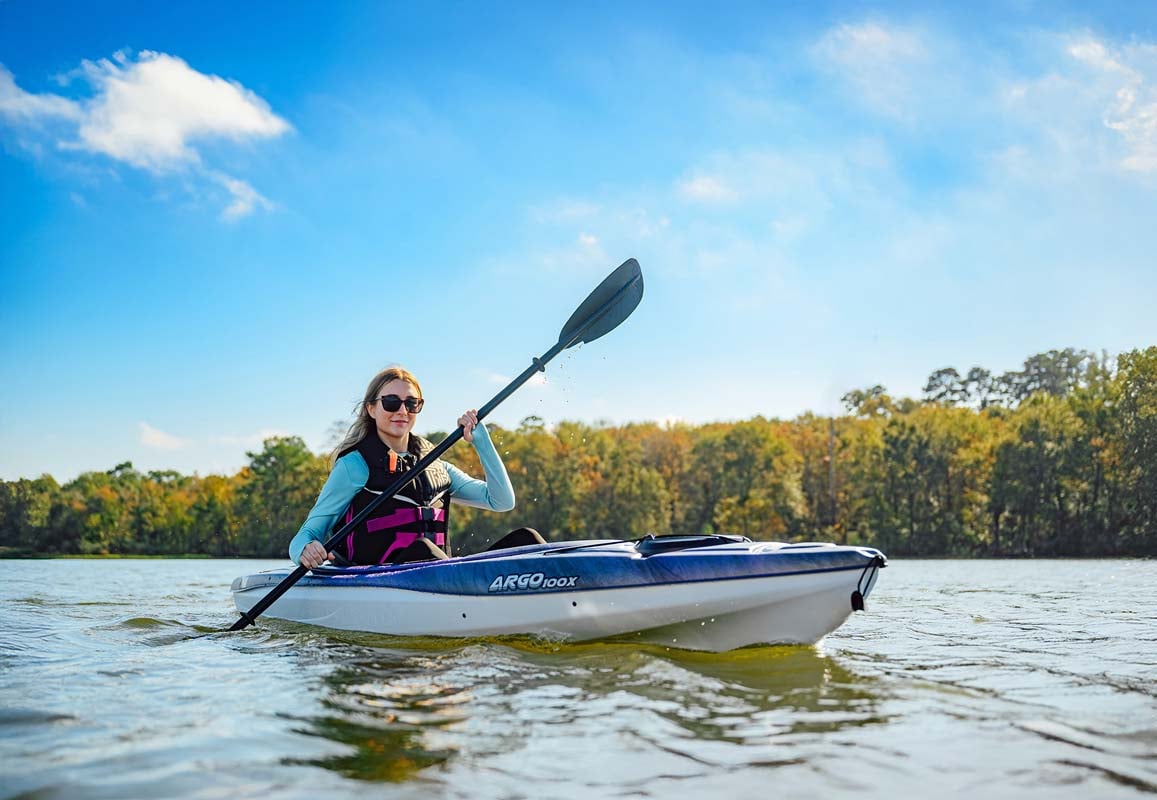
A plastic, sit-in alternative, the Canadian-designed Pelican Argo 100X weighs just a little more at 16.3kg, but costs about half the price. Thanks to its lightweight construction and 3m length, it’s easily managed by a single paddler. There’s a sealed hatch storage space at the front and a mesh-covered storage area to the rear, and the comfy seat comes with an adjustable backrest.
Sit-on kayaks for fishing
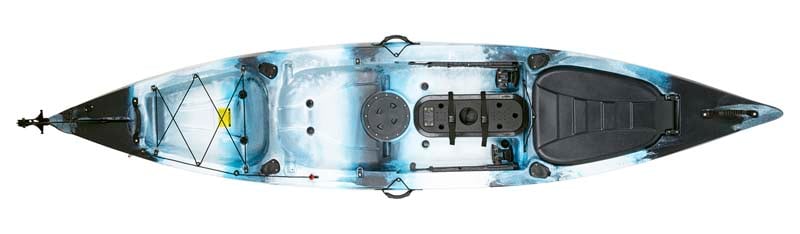
Sit-on kayaks tend to be a little more affordable, so there are plenty of cheapies on the market that are just fine for kids to splash about. However, if you want to cover some distance then choose a sit-on kayak that tracks well.
Designed for fishing, the Seak Mako is far heavier than others mentioned, so consider whether you can single-handedly manage this 35kg fishing platform. At 3.9m, it provides two dry compartments forward, and a large open area aft – plus five rodholders.
Kayaks for surfing
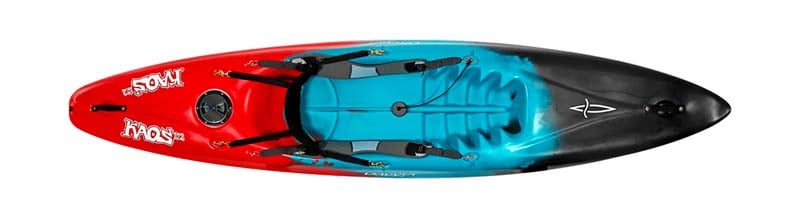
Part surfing longboard and part sit-on kayak, the Dagger Kaos will thrill paddlers who prefer to stray from calm water into the breakers. The 3.1m length, 24kg weight and sleeker design makes it more manoeuvrable in the swell, and a moulded seat with adjustable backband support provides comfort.
Foil boards
Hydrofoiling boards
When it comes to versatility, you can’t beat a hydrofoil or foil board to get moving on almost any stretch of water. By adding a hydrofoil to the base of a board, riders can harness the power of the wind, waves and ocean swell to create lift, elevate the board above the water surface and, by reducing drag, ride waves and ocean swell at surprisingly fast speeds.
There are foil boards for surfing waves (prone boards), for downwinding, which is riding the swell over long distances along coastlines beyond the surf line (sometimes with a paddle), and for wing foiling in which a rider uses a hand-held inflatable wing to catch the wind and lift themselves sky-high.
If you’re new to the sport, expect a baffling choice of boards, wings and foils in all sizes and shapes, designed for all foiling styles, skill levels and budgets. There are even e-foil boards that allow you to play in calm, flat, windless conditions.
When choosing a beginner set-up, look for a board with extra width, extra length and higher volume – packages start from around $3000 and can include boards made from bamboo or fibreglass which are cheaper, but easier to ding.
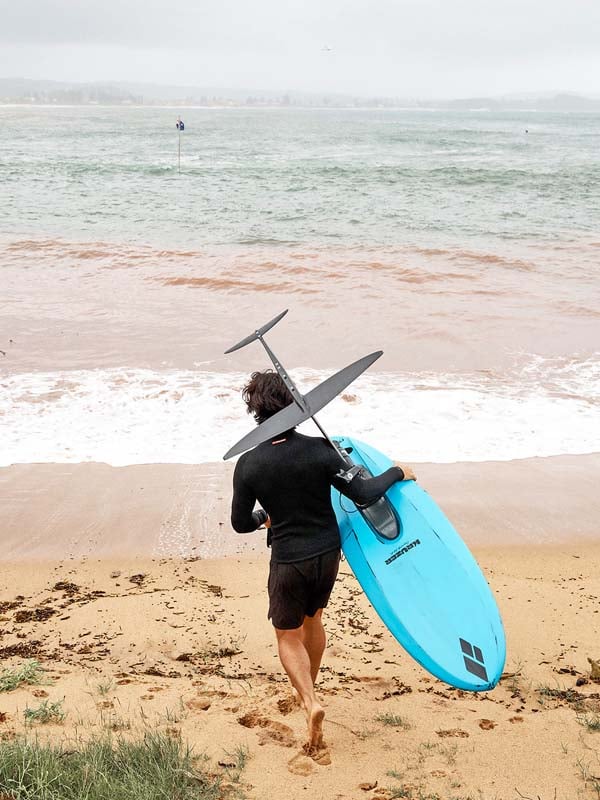
Buying a hydrofoil board
Mid-length boards are a great place to start as they sit somewhere between boards designed purely for surfing, winging and downwind riding. Appletree’s high-performance Skipper range covers all bases. Choose the Skipper Downwind V2 for downwind SUP foiling, the Skipper Midlength for prone, wind and parawing riders, for surfing and winging have a look at the Skipper DW Prone, the Skipper Wing Foil or the Skipper Prone.
Australian-made Amos Shapes targets beginners with its best-selling KrUzer, a streamlined, mid-length board designed for waves, with a concave deck and narrower tail to improve paddle power. You’ll need to add a regular foil kit or an electric hybrid Foil Drive Assist.
Also from Amos, the KrUzer RTS was designed to team with Foil Drive that provides continuous electric propulsion to give riders a boost on take-off and help move them into position on the waves.
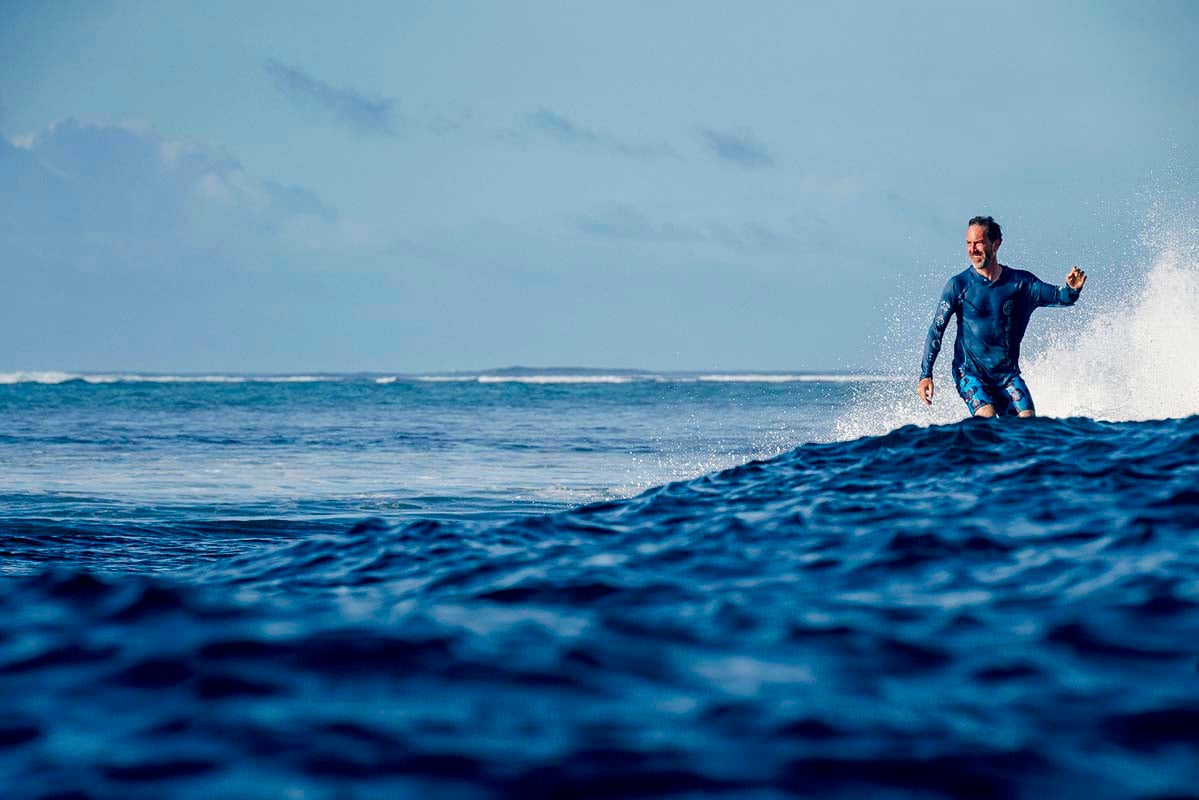
Full foil package
Melbourne-based Kite Republic packages the sporty, carbon-strengthened Core Roamer S board with your choice of a Core Halo Pro or XC wing, plus a Unifoil progression foil set. You can customise the package to your size of wing and board, and the kit includes wrist and waist leashes, a pump, bag and free shipping.
Kitepower sells another affordable wing foiling package with the wide, beginner-friendly SiC Mako (1.7m) board and Ozone WASP V3 wing. The package comes with a pump, an Axis SES foil kit, and an Azone wind harness.
Kite surfing
Kite surfing packages
Long before wing foiling rose to popularity, kite surfers were launching themselves sky-high using a parachute-like kite and a board. There are three basic styles: performance C kites (for pros), easier-to-use, flatter bow kits, and SLE kites that use bridle lines to support the kite’s leading edge – plus hybrid designs, too. Beginner packages start at around $2900 – see kitepower.com.au
Sea scooters
Underwater sea scooters
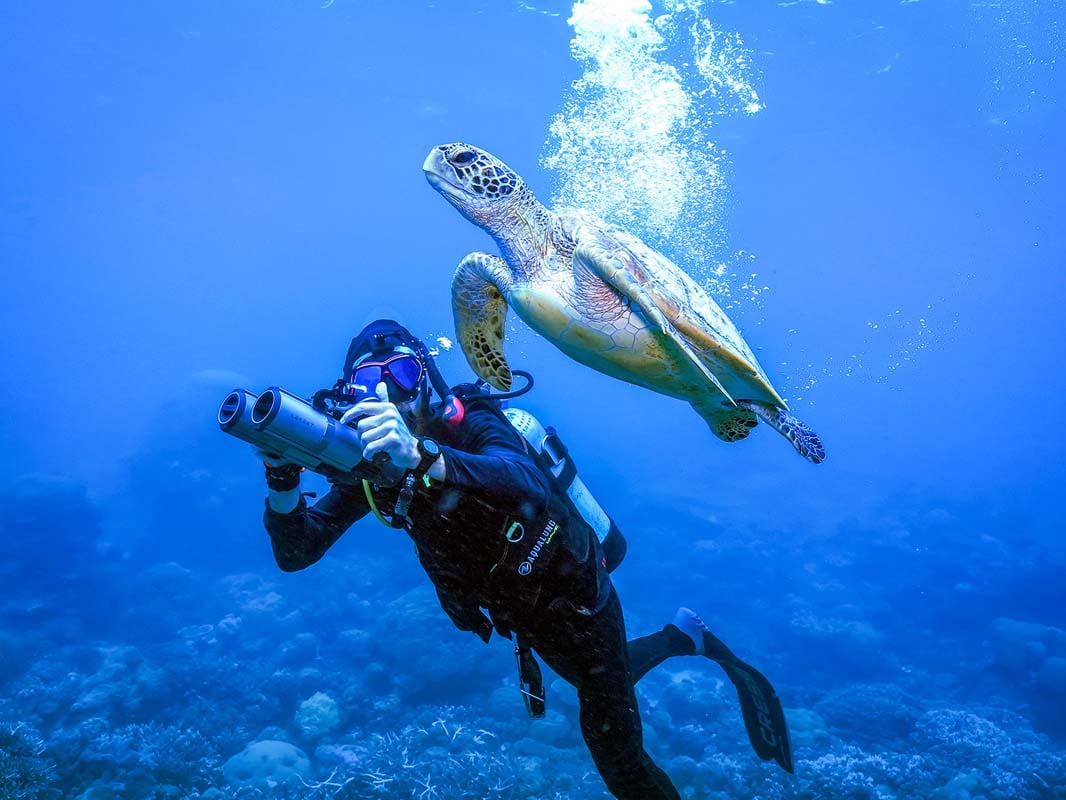
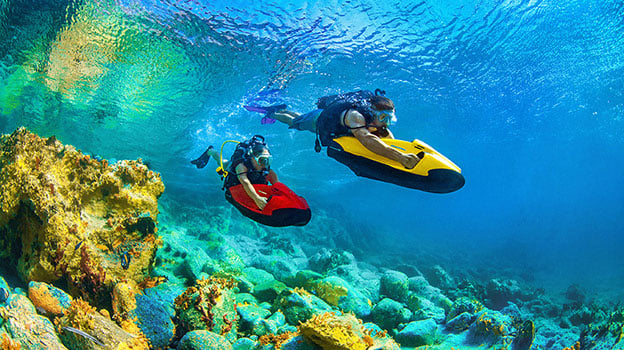
When buying a sea scooter, consider who’s going to use it and under what conditions. A certified diver might favour a compact, lightweight unit capable of reaching depths of 60m, and enough speed to overcome strong currents. That unit will look very different to one suitable for families who might use it for shallow-water snorkelling.
Kids need to be supervised to ensure they don’t find themselves too deep, and since many scooters possess only slight positive buoyancy, consider attaching an inflatable sleeve or even a life vest to young users.
The Nautica Marine 500 is a compact dual-handed unit powered by dual thrusters. It’s capable of reaching speeds of 5.6km/h, has a run time of 45 minutes, and a three-hour charge time.
The Sublue Tini weighs just 3kg and reaches speeds of up to 5km/h for a maximum of 45 minutes (with standard 98W battery). To increase session time to 70 minutes, upgrade to a 158W battery, or buy two units and connect them with a dual rail arm.
For underwater adventurers, the Edge Smart Drive K5 ticks a lot of boxes. With a depth rating of 50m and top speed of 7.2km/h, it’s also ultra compact, offers 60 minutes underwater, provides a GoPro quick-release bracket, and weighs just 2.2kg.
A compact, albeit heavier option for serious divers, the foldable Nautica J-Class offers dual motors powering you to speeds of 8km/h, a depth of 40m, and a 40-minute run time (3 to 4 hours for charging).
Jobe’s self-floating Infiniti can reach depths of 30m at up to 5km/h. Two batteries provide around 75 minutes of run time, there’s a GoPro mount, and the package includes a snorkel set.
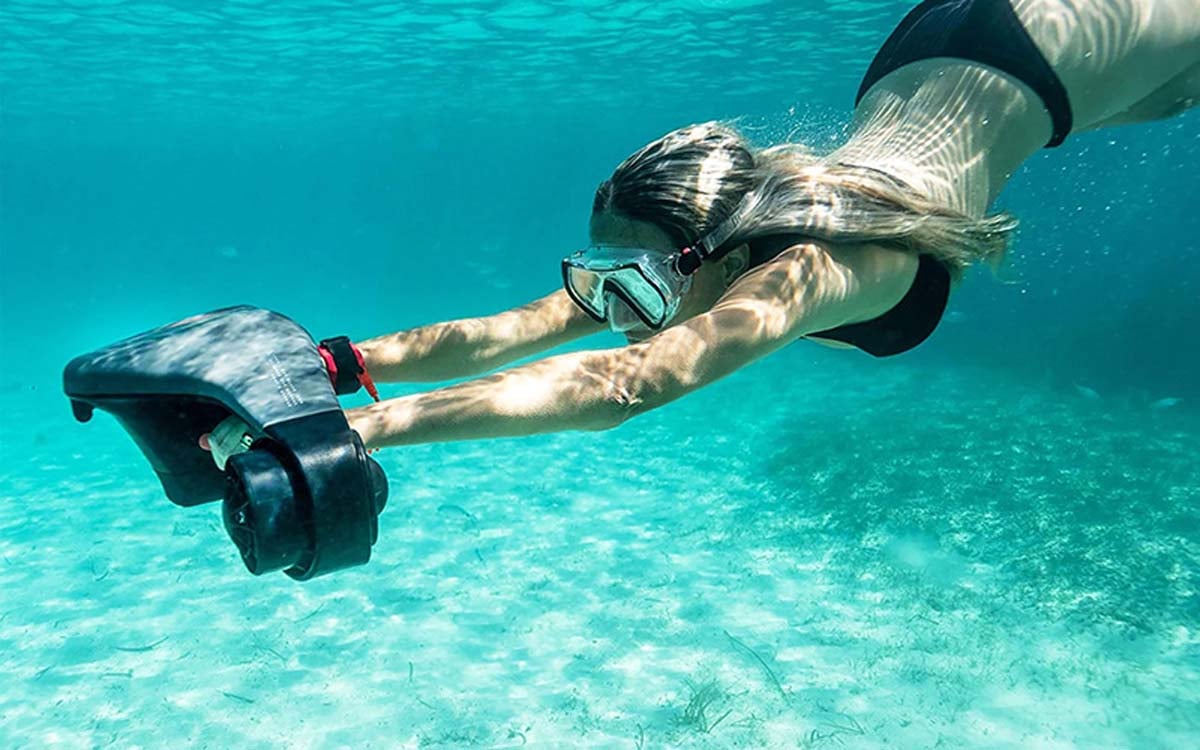
Pro-level sea scooters
You should expect big things from the Lefeet P1 sea scooter. It’s lightweight at 2.3kg, boasts a top speed of 7.2km/h, offers 60 minutes underwater, and takes you to a maximum depth of 60m – all with a standard battery and single thruster. Adding an XR battery increases power to 160W, ramps up underwater speeds to 9.2km/h and extends swim time to 90 minutes.
If you need more of everything, use a dual rail arm to combine the thrust of two Lefeet P1 units.
SUPs
What SUP?
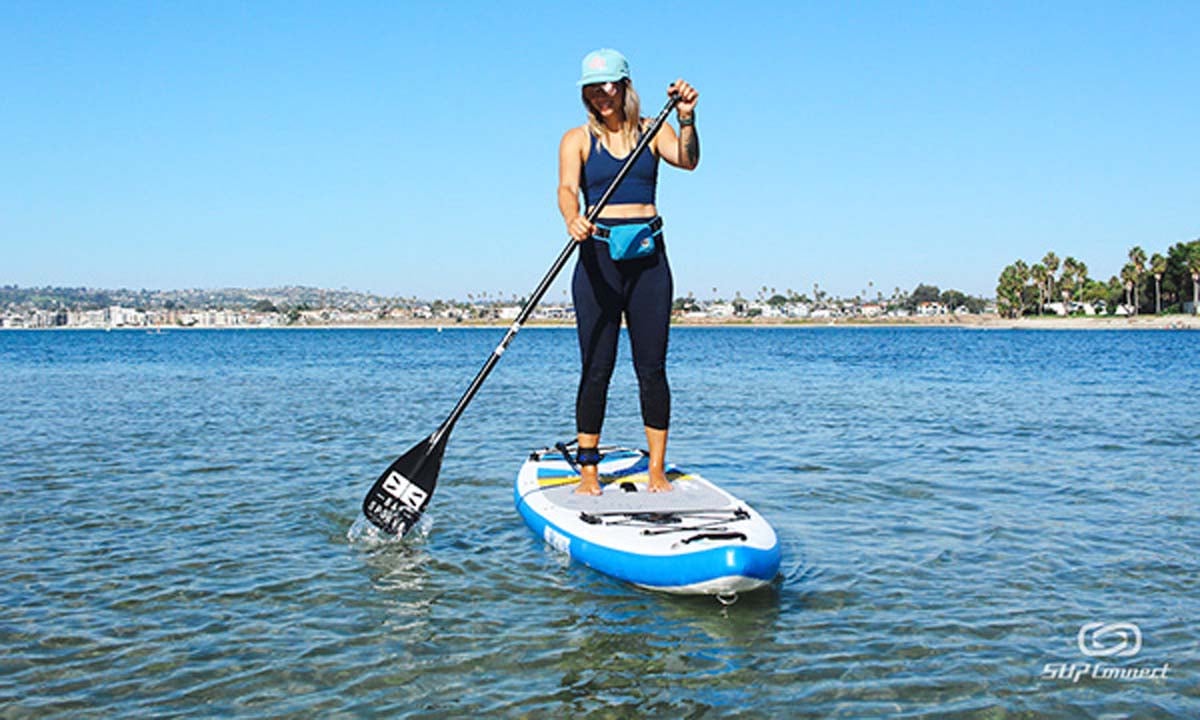
Like all board-riding sports, you can make an affordable SUP (Stand Up Paddle Board) purchase or invest in a high-performance board, depending on budget and skill level. Basically, the bigger the SUP, the more stable it will be, and bigger is better when you’re a beginner, a larger-sized rider, do yoga on your SUP, or regularly exercise with a child or pet.
As your skills and agility improve, you may want to upgrade to a longer and faster board to cover bigger distances, or choose a short and narrow SUP for more manoeuvrability when riding waves. Beginner SUPs range from 3.1m (10ft 2in) to 3.2m (10ft 6in), with a thickness of 15cm.
There are pros and cons to choosing an inflatable over a hard SUP, but most boaters find inflatable models more compact and easier to store onboard. Invest in the most efficient pump you can afford.
The Jobe Yarra SUP is a stable, lightweight all-rounder, especially for beginners. At 3.2m (10ft 6in), it handles a combined load of up to 140kg, making it good for parents who never escape the boat without a child or pet in tow.
If price is paramount, the Fuel Aqua 10ft 2in tempts. Its 7.5kg weight makes it manageable to carry, and it bears a load of up to 150kg.
SUPs for more experienced riders
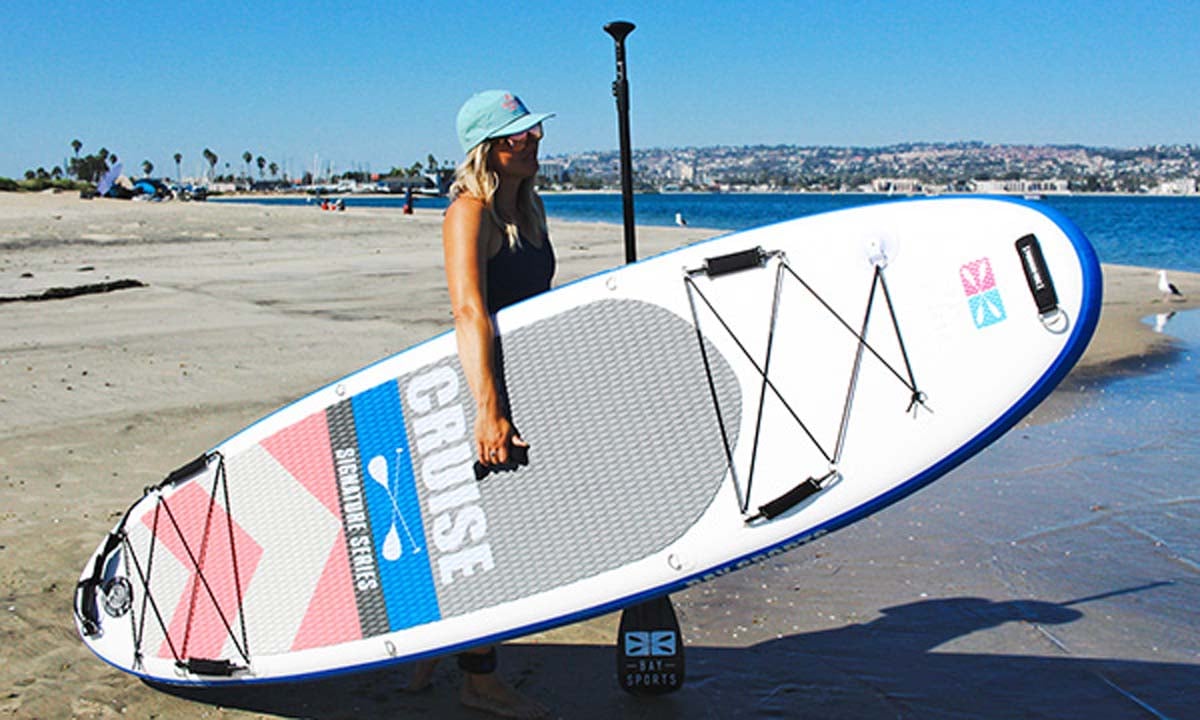
The Australian-owned Bay Sports Tour (3.5m, 11ft 6in) prioritises speed with a streamlined but no-less stable platform. It’s a little narrower than your average board at 81.3cm and a little thinner at 12.7cm, but with a 292l volume, and weighing 8.9kg, the Tour supports riders up to 130kg.
Similar in width and thickness to the Tour, the Bay Sports Cruise is a shorter, more agile and lightweight board for smaller riders who might be keen on braving the waves. The board’s tapered tail makes it more manoeuvrable, and at 7.65kg, it’s easier for kids to carry.
Don't forget ** Club Marine members can get a discount on gear from a range of retail partners.
THE FULL ARTICLE OF WATER TOYS RAN IN THE OCT-NOV (40.5) ISSUE OF CLUB MARINE MAGAZINE.

RELATED ARTICLES



*Terms and conditions apply
Any discounts offered are applied to our standard rates. Promotional or other discounts may apply from time to time. Minimum premiums may apply. Any discounts/entitlements only apply to the extent any minimum premium is not reached. Where discounts are applied, your premium is subject to rounding. If you are eligible for more than one, we also apply each of them in a predetermined order to the premium (excluding taxes and government charges) as reduced by any prior applied discounts/entitlements.
Any advice here does not take into account your individual objectives, financial situation or needs. Terms, conditions, limits and exclusions apply. Before making a decision about Club Marine boat insurance, consider the Product Disclosure Statement (PDS)/Policy Document and Supplementary PDS (if applicable). Where applicable, the PDS/Policy Document, Supplementary PDS and Target Market Determination (TMD) for Club Marine boat insurance are available on this website. We do not provide any form of advice if you call us to enquire about or purchase a product.
Club Marine Limited (ABN 12 007 588 347), AFSL 236916 issues Club Marine boat insurance and handles and settles claims as agent for the insurer Allianz Australia Insurance Limited (ABN 15 000 122 850) AFSL 234708 (Allianz). Club Marine Limited is a related body corporate of Allianz. Copyright © 2026 Allianz Australia Limited.